So we're getting a new dishwasher. The old dishwasher has at long last given up the ghost. Instead of pumping water, it makes a terrible noise that we have interpreted to mean that there will be no more dishes washed until a repairman shows up. There will be no repairman. Rather, there will be a delivery and the old dishwasher will be added to some mountain of trash somewhere.
This is a bit of a relief. The dishwasher is 11 years old. I'm not sure of the ratio of kitchen appliance years to human years, but I would say that it would be eligible for the senior discount on Cascade if such a thing existed. However, that's not why we're relieved by it's refusal to wash dishes. You see, three years ago, we did call the appliance repairman. The dishwasher was leaking water on the floor. And the timer sometimes stuck partway through the cycle and would run indefinitely if not manually moved on to the next stage of the cycle.
When the repairman walked through the door, I realized that I had already incurred some sort of financial obligation whether the appliance was repaired or not. After an examination, the diagnosis was given -- $275 to fix the water on the floor, another couple of hundred to fix the timer. I considered the matter. The repairman was standing there. I owed him money already. Life was crazy and did not include time to shop for a new dishwasher. However, fixing the old one completely would cost more than buying a new one. I compromised and had him fix the leak but not the timer. My husband was not thrilled with that decision but we were back in the dishwashing business with less pain than any alternative fix.
Time passed. As my husband and I headed out to shop for a new dishwasher a couple of weeks ago, we were discussing what features we wanted on the new one. As we considered shelf arrangement and noise and number of cycles, I decided to throw in a dream feature. Would it, could it, be possible that we could find a dishwasher that would wash the dishes completely unattended? Would we be able to find one that required only a push of the button and no further attention? Could we start a load of dishes on our way out the door or to bed? If it had a delay start, could we use it?
For just short of three years, the routine has been: 1)start the dishwasher; 2)set the stove timer to 20 minutes; 3)arrange to be within hearing range of the kitchen in 20 minutes. 4)at the sound of the buzzer, return to the kitchen to turn off the stove timer and nudge the dial on the dishwasher to move on in the cycle.
In the days before the dishwasher quit working, the stove timer seemed to tire of this constant babysitting of the dishwasher and was going off less reliably. It looked like we would need to recruit the microwave timer to take over. The dishwasher had become a burden to the entire kitchen. Only the refrigerator was spared. (It has its own issues.)
We're still washing dishes by hand at this point, but the order is in and the new unit should show up this week. The report is that it does indeed require no human intervention once the button is pushed.
Life is good.
Sunday, July 08, 2007


Tuesday, June 26, 2007
New vistas
During the winter, I started riding our stationary bike during daily morning phone calls from my daughter in Denver as she commuted to work. The distraction of the phone call kept me from being distracted by other things and wandering off after a few rotations of the pedals.
Now it’s summer and phone calls from Denver come much less frequently. And riding a bicycle inside is less attractive when the mornings are so nice outside. We have several bikes sitting around, left over from the days when our household population was greater, however, only one of them has been kept functional. I started taking a morning ride on it.
I’ve been riding in a bowl. Every morning I turn right at the end of the driveway onto our gravel road. Down a little hill, up a bigger hill, down the other side on a gentle slope to where it tees onto a paved county road. Then I turn left and start to tackle a long uphill slope. I can’t make it to the top. I go as far as I can up the north rim of my bowl and then turn around. At that point I don’t have to touch the pedals for maybe a third of a mile until I reach the base of the steepest hill on my route. I can’t make it up that hill. I go as far as I can up the south rim of my bowl and then turn around and coast down the hill and start the arduous process of repaying all of the energy I saved while coasting the other direction. It’s not at all a steep slope back to our gravel road, just long and mostly uphill. Once back on the gravel, everything comes easily and I’m soon back home, albeit with legs of rubber in my current state of unfitness. The whole process takes between 10 and 15 minutes.
Over the weekend, my husband looked into getting another bike on the road so we could both ride. First he tried the big one. It needed new tires that would cost almost as much as a replacement for the bike. He donated it to the bike repair shop and turned to one of the smaller ones. One tire wouldn’t hold air. Last night, he pulled out another bike and got it going. That’s the one I took this morning.
It’s nice. Big tires. 21 speeds! (Up from 15.) Smooth shifts. I like it. (Thanks, Sondra.) I still didn’t make it to the top of the north rim of my bowl but I topped the south rim. I stood on the top of the steep hill looking at the uncharted territory ahead. Now what happens? Dare I venture outside my familiar little bowl?
Not this morning. I’ve been around long enough to figure out that adding another downhill segment to my outbound route means adding another uphill segment to my return route. (I’m sure there’s some profound lesson to ponder in that, but not today.) There are certainly new possibilities now, however. Civilization lies over that south rim – church, town, the library. Who knows where future outings might take me!
Now it’s summer and phone calls from Denver come much less frequently. And riding a bicycle inside is less attractive when the mornings are so nice outside. We have several bikes sitting around, left over from the days when our household population was greater, however, only one of them has been kept functional. I started taking a morning ride on it.
I’ve been riding in a bowl. Every morning I turn right at the end of the driveway onto our gravel road. Down a little hill, up a bigger hill, down the other side on a gentle slope to where it tees onto a paved county road. Then I turn left and start to tackle a long uphill slope. I can’t make it to the top. I go as far as I can up the north rim of my bowl and then turn around. At that point I don’t have to touch the pedals for maybe a third of a mile until I reach the base of the steepest hill on my route. I can’t make it up that hill. I go as far as I can up the south rim of my bowl and then turn around and coast down the hill and start the arduous process of repaying all of the energy I saved while coasting the other direction. It’s not at all a steep slope back to our gravel road, just long and mostly uphill. Once back on the gravel, everything comes easily and I’m soon back home, albeit with legs of rubber in my current state of unfitness. The whole process takes between 10 and 15 minutes.
Over the weekend, my husband looked into getting another bike on the road so we could both ride. First he tried the big one. It needed new tires that would cost almost as much as a replacement for the bike. He donated it to the bike repair shop and turned to one of the smaller ones. One tire wouldn’t hold air. Last night, he pulled out another bike and got it going. That’s the one I took this morning.
It’s nice. Big tires. 21 speeds! (Up from 15.) Smooth shifts. I like it. (Thanks, Sondra.) I still didn’t make it to the top of the north rim of my bowl but I topped the south rim. I stood on the top of the steep hill looking at the uncharted territory ahead. Now what happens? Dare I venture outside my familiar little bowl?
Not this morning. I’ve been around long enough to figure out that adding another downhill segment to my outbound route means adding another uphill segment to my return route. (I’m sure there’s some profound lesson to ponder in that, but not today.) There are certainly new possibilities now, however. Civilization lies over that south rim – church, town, the library. Who knows where future outings might take me!
Sunday, June 10, 2007
First draft
I am a habitual reader of the Christian scriptures. I start nearly every day with four short passages from the Bible and have done so for quite a few years. I was also a “Bible quizzer” as a teen, spending an entire year studying and memorizing passages from either one long book or a couple of shorter books from the New Testament.
In the world of theology, I am part of the Wesleyan/Arminian camp as opposed to being a Calvinist. Among other things, that affects my view of scripture. We believe that scripture is “given by divine inspiration, inerrantly revealing the will of God concerning us in all things necessary to our salvation”.* This is not the view that says God dictated every word nor that every word concerning every subject is factually true in a scientific way. It is a confidence that everything we need to know in order to form a relationship with God can be discovered in the Christian scriptures. They were written by ordinary people as the story of how God has revealed himself to mankind. Those who wrote were not aware that they were writing the Bible.
Those who believe that the Bible was dictated by God and is inerrant in all things, that those who wrote were simply scribes recording exactly what God told them to say, see scripture as miraculously given. Although I don’t hold to that view, I am still amazed by the process by which the Bible has come to us: Someone had to write the words; someone had to see value in those words and preserve them; people had to carefully copy the words and distribute them widely enough that not all the copies were destroyed by fire or flood or other disasters; someone had to gather them up and decide which ones were worthy of being called scripture and which ones were not. I know that the writings of the Greek philosophers were preserved from the same time period, that it didn’t take divine inspiration for ancient literature to survive, but I am still impressed by what has come to us, not only the richness of the collection we have, but the coherency that runs through it.
The other thing that impresses me is the quality of the writing. I not only read, I also do some writing. And I am a compulsive editor of my own words. Even now as I type, I keep going back to tweak a word here and one there, strike an entire sentence or even a paragraph. If I were writing with pen and ink, there would be strikeouts all over the page. And for what? A blog entry! How many will even read it?
I think of the apostle Paul writing letters to churches he can’t visit because he is imprisoned. Perhaps he is dictating to a scribe. He is concerned about the churches and has some points to make. Does he start with an outline? Does he realize that people will be outlining what he is about to dictate for hundreds and thousands of years? Does he know that they will build entire sermons and even doctrine around his choice of Greek words? How much thought did he put into those word choices? Is this where inspiration comes in?
I have written difficult letters. Sometimes, for the most difficult, I have typed out what I wanted to say, edited it, let it simmer for a while, gone back to it and done more editing and then transcribed it onto paper so that it would have the personal touch of being handwritten rather than coming off my computer printer. Did Paul do any editing at all? Were there scratch-outs on his paper? Did he have an edited version copied onto fresh parchment before sending it out? Or are we looking at first drafts in the New Testament?
Even with a good word processor and plenty of opportunity for revision, I can’t imagine writing something that would stand up to the type of scrutiny the Bible gets. And on scrolls of parchment?
I have read that some parts of the New Testament are written in less elegant Greek than others, that one task of the translator is to decide whether to reflect the coarseness of the Greek manuscripts in the translation. Still, there in not a book among the 27 that doesn’t have an inspirational message.
I guess I just need more inspiration. Or more editing.
*from Article IV from the statements of faith, Church of the Nazarene Manual.
In the world of theology, I am part of the Wesleyan/Arminian camp as opposed to being a Calvinist. Among other things, that affects my view of scripture. We believe that scripture is “given by divine inspiration, inerrantly revealing the will of God concerning us in all things necessary to our salvation”.* This is not the view that says God dictated every word nor that every word concerning every subject is factually true in a scientific way. It is a confidence that everything we need to know in order to form a relationship with God can be discovered in the Christian scriptures. They were written by ordinary people as the story of how God has revealed himself to mankind. Those who wrote were not aware that they were writing the Bible.
Those who believe that the Bible was dictated by God and is inerrant in all things, that those who wrote were simply scribes recording exactly what God told them to say, see scripture as miraculously given. Although I don’t hold to that view, I am still amazed by the process by which the Bible has come to us: Someone had to write the words; someone had to see value in those words and preserve them; people had to carefully copy the words and distribute them widely enough that not all the copies were destroyed by fire or flood or other disasters; someone had to gather them up and decide which ones were worthy of being called scripture and which ones were not. I know that the writings of the Greek philosophers were preserved from the same time period, that it didn’t take divine inspiration for ancient literature to survive, but I am still impressed by what has come to us, not only the richness of the collection we have, but the coherency that runs through it.
The other thing that impresses me is the quality of the writing. I not only read, I also do some writing. And I am a compulsive editor of my own words. Even now as I type, I keep going back to tweak a word here and one there, strike an entire sentence or even a paragraph. If I were writing with pen and ink, there would be strikeouts all over the page. And for what? A blog entry! How many will even read it?
I think of the apostle Paul writing letters to churches he can’t visit because he is imprisoned. Perhaps he is dictating to a scribe. He is concerned about the churches and has some points to make. Does he start with an outline? Does he realize that people will be outlining what he is about to dictate for hundreds and thousands of years? Does he know that they will build entire sermons and even doctrine around his choice of Greek words? How much thought did he put into those word choices? Is this where inspiration comes in?
I have written difficult letters. Sometimes, for the most difficult, I have typed out what I wanted to say, edited it, let it simmer for a while, gone back to it and done more editing and then transcribed it onto paper so that it would have the personal touch of being handwritten rather than coming off my computer printer. Did Paul do any editing at all? Were there scratch-outs on his paper? Did he have an edited version copied onto fresh parchment before sending it out? Or are we looking at first drafts in the New Testament?
Even with a good word processor and plenty of opportunity for revision, I can’t imagine writing something that would stand up to the type of scrutiny the Bible gets. And on scrolls of parchment?
I have read that some parts of the New Testament are written in less elegant Greek than others, that one task of the translator is to decide whether to reflect the coarseness of the Greek manuscripts in the translation. Still, there in not a book among the 27 that doesn’t have an inspirational message.
I guess I just need more inspiration. Or more editing.
*from Article IV from the statements of faith, Church of the Nazarene Manual.
Monday, April 09, 2007
Taking time to be sick
One morning last week I woke up with the type of sore throat that generally signals the onset of something more. Sometimes I can shake these things off if I take it easy for a few days -- sleep a little more, relax, eat right, etc. Alas, this was not one of those times. Maybe if I had slept in on Saturday morning. But somebody had to open the library and the lot fell to me on this Saturday before Easter. Maybe if I had taken Sunday off. But it was Easter! I had a Sunday School lesson to teach and multiple songs to accompany on the piano. Sure, church could have happened without me, but it certainly wouldn't have gone off as planned. So I took cold medicine and headed to church. I did take a nap for an hour or so on Sunday afternoon, but there was a party at our house in the evening. That took some serious energy even with lots of help from my husband and daughter.
Now it's Monday morning. I'm sick. My nothe ith all clogged up. My voice is scratchy. I cough and sneeze. I had a headache all night and didn't sleep well. If you don't mind, it would be really nice to stop the world for a day or so and let me get off. Or if the world must go on, maybe I won't be missed too much if I opt out of today.
I sometimes think of Jim Henson (creator of the muppets) at times like this. He didn't have time to be sick. He was too busy for sickness. But he had time to die of pneumonia at age 53.
I don't think I'm anywhere close to a fatal case of pneumonia, but it makes for good justification to take a day off now and then and just be sick.
Would someone please pass the tissues and aspirin?
Now it's Monday morning. I'm sick. My nothe ith all clogged up. My voice is scratchy. I cough and sneeze. I had a headache all night and didn't sleep well. If you don't mind, it would be really nice to stop the world for a day or so and let me get off. Or if the world must go on, maybe I won't be missed too much if I opt out of today.
I sometimes think of Jim Henson (creator of the muppets) at times like this. He didn't have time to be sick. He was too busy for sickness. But he had time to die of pneumonia at age 53.
I don't think I'm anywhere close to a fatal case of pneumonia, but it makes for good justification to take a day off now and then and just be sick.
Would someone please pass the tissues and aspirin?
Saturday, March 31, 2007
The power of the clock
OK, I give up. The clock has won.
For 35 years or so, Indiana did not participate in the illusion known as Daylight Savings Time. Now we do. The county where I live managed to put it off an extra year by strategically changing time zones, but we eventually were forced to change our clocks last fall. As you know if you’re a faithful reader, I declined to do so. I have had my clock radio set to get the 6:30 a.m. (EST) local news and weather for years. I had no desire to get up at a different time. So when we went on Daylight Squandering Time (aka Central Standard Time) in October, I refused to get up an hour later just so we could have sunset at 4:30 pm in the winter. For a couple of months, I didn’t change my clock at all, but when it became clear that the request to return to Eastern time would not be granted any time soon, I finally gave in. However, I set my alarm for 5:30 am CST. That’s 6:30 am EST. I would still wake up at the same time as always and not sleep through precious winter daylight.
So along comes March 11 and the big move to Central Daylight Savings Time. CDT is actually the same as EST, which is what we were on year round until our governor decided that we should change time like everyone else. (I hope everyone else doesn’t start jumping off cliffs.) Finally, we’re back on “normal” time. I can change my alarm to 6:30 and everything will be back to normal.
Except I’ve grown used to waking up when the clock reads 5:30 am. And I’m an aging morning person. I don’t need as much sleep as when I was younger and I tend to get less by waking up earlier. (Even when I was young, “sleeping in” for me meant not getting up until 8:00 am.) My internal alarm clock simply noticed the new time on the clock and started going off an hour early. The radio comes on at 6:30 but I generally wake up by 5:30.
I actually find the internal alarm rather amusing. Usually, I simply drift into wakefulness in the morning. Occasionally -- usually because I’ve been up late -- the radio wakes me up. But every once in a while I’m sound asleep at 5:30 or 6:30 or whenever my inner clock is set for and the internal alarm goes off. A silent nudge will intrude into my dreams and say, “Hey, it’s time to wake up!” I then experience the same irresistible surfacing as when an external alarm yanks me out of sleep. This consistently happens at my usual waking time. Some part of me knows what time it is even when I'm sleeping.
The internal alarm would be quite handy if the part of me that fears oversleeping were confident that it could be trusted. It doesn’t work that way. If I need to wake up at a definite time before daylight without an alarm clock, that worrywart part of me handles it by waking me up every hour on the hour starting around 3 am, a rather annoying solution. So I set a real alarm when it’s important that I wake up before daylight. The internal alarm mainly gets exercised on Saturdays when I have no reason to get up early and there’s no 6:30 news on the radio so I have the alarm turned off. I’m all set to sleep until, oh, 7:30, or even 8:00, and actually managing to ignore dawn creeping in until here comes that nudge dragging me out of sleep. And now it is set an hour earlier! Thanks a lot, Benjamin Franklin and Mitch “not my man” Daniels.
Now if only I would start going to sleep at the appropriate time for this new hour of rising. I’m not saving electricity. I’m just burning the candle at both ends.
For 35 years or so, Indiana did not participate in the illusion known as Daylight Savings Time. Now we do. The county where I live managed to put it off an extra year by strategically changing time zones, but we eventually were forced to change our clocks last fall. As you know if you’re a faithful reader, I declined to do so. I have had my clock radio set to get the 6:30 a.m. (EST) local news and weather for years. I had no desire to get up at a different time. So when we went on Daylight Squandering Time (aka Central Standard Time) in October, I refused to get up an hour later just so we could have sunset at 4:30 pm in the winter. For a couple of months, I didn’t change my clock at all, but when it became clear that the request to return to Eastern time would not be granted any time soon, I finally gave in. However, I set my alarm for 5:30 am CST. That’s 6:30 am EST. I would still wake up at the same time as always and not sleep through precious winter daylight.
So along comes March 11 and the big move to Central Daylight Savings Time. CDT is actually the same as EST, which is what we were on year round until our governor decided that we should change time like everyone else. (I hope everyone else doesn’t start jumping off cliffs.) Finally, we’re back on “normal” time. I can change my alarm to 6:30 and everything will be back to normal.
Except I’ve grown used to waking up when the clock reads 5:30 am. And I’m an aging morning person. I don’t need as much sleep as when I was younger and I tend to get less by waking up earlier. (Even when I was young, “sleeping in” for me meant not getting up until 8:00 am.) My internal alarm clock simply noticed the new time on the clock and started going off an hour early. The radio comes on at 6:30 but I generally wake up by 5:30.
I actually find the internal alarm rather amusing. Usually, I simply drift into wakefulness in the morning. Occasionally -- usually because I’ve been up late -- the radio wakes me up. But every once in a while I’m sound asleep at 5:30 or 6:30 or whenever my inner clock is set for and the internal alarm goes off. A silent nudge will intrude into my dreams and say, “Hey, it’s time to wake up!” I then experience the same irresistible surfacing as when an external alarm yanks me out of sleep. This consistently happens at my usual waking time. Some part of me knows what time it is even when I'm sleeping.
The internal alarm would be quite handy if the part of me that fears oversleeping were confident that it could be trusted. It doesn’t work that way. If I need to wake up at a definite time before daylight without an alarm clock, that worrywart part of me handles it by waking me up every hour on the hour starting around 3 am, a rather annoying solution. So I set a real alarm when it’s important that I wake up before daylight. The internal alarm mainly gets exercised on Saturdays when I have no reason to get up early and there’s no 6:30 news on the radio so I have the alarm turned off. I’m all set to sleep until, oh, 7:30, or even 8:00, and actually managing to ignore dawn creeping in until here comes that nudge dragging me out of sleep. And now it is set an hour earlier! Thanks a lot, Benjamin Franklin and Mitch “not my man” Daniels.
Now if only I would start going to sleep at the appropriate time for this new hour of rising. I’m not saving electricity. I’m just burning the candle at both ends.
Sunday, March 11, 2007
Poor, neglected blog
I have a confession to make. Sometimes I forget that I have a blog. Maybe you're not surprised to hear that.
Anyway, it's not like nothing has been happening. I just haven't been writing about it here. I've been busy. I've even finished some books and started others. Maybe I'll check out this new easier template stuff on the new blogger and see if I can update my reading list.
My husband and I went to a conference in Kansas City a couple of weeks ago. That was fun. We even got to eat pizza with Andrew, Terry, and Josh, our favorite KC residents.
The conference was called M7 (short for Mission 2007) and was sponsored by the USA/Canada division of the International Church of the Nazarene. There were around 4,000 people there, a much smaller venue than the General Assemblies that happen every four years. There were 240 workshops being offered in six time slots. It was difficult to choose six out of the 240, but I was pleased with the workshops I attended. The key words in their descriptions were either "spiritual formation" or "emergent".
I shared my four points for worship from my last entry with someone. That person noted that I am on my way to having an outline for a bestselling book.
Worship
Orchestrated
Responsive
S
H
I
Participatory.
I'm three points short of a full acronym. Maybe I'll conduct a contest to come up with the other three points. Tell you what. I'll give the winner 5% of my take off the bestseller when it comes out. Of course, if you have the other three points, you can simply add my four points to them and write the book yourself and keep 100% of the profit -- after tithe and taxes. (I presume that one of the points might have to do with giving and that tithing the proceeds of the book would be sort of a given.)
I'll pass on the notes I brought away from one of the workshops. They actually had nothing at all to do with the workshop. I copied them off the back of a t-shirt worn by a college student sitting a few rows in front of me.
Anyway, it's not like nothing has been happening. I just haven't been writing about it here. I've been busy. I've even finished some books and started others. Maybe I'll check out this new easier template stuff on the new blogger and see if I can update my reading list.
My husband and I went to a conference in Kansas City a couple of weeks ago. That was fun. We even got to eat pizza with Andrew, Terry, and Josh, our favorite KC residents.
The conference was called M7 (short for Mission 2007) and was sponsored by the USA/Canada division of the International Church of the Nazarene. There were around 4,000 people there, a much smaller venue than the General Assemblies that happen every four years. There were 240 workshops being offered in six time slots. It was difficult to choose six out of the 240, but I was pleased with the workshops I attended. The key words in their descriptions were either "spiritual formation" or "emergent".
I shared my four points for worship from my last entry with someone. That person noted that I am on my way to having an outline for a bestselling book.
Worship
Orchestrated
Responsive
S
H
I
Participatory.
I'm three points short of a full acronym. Maybe I'll conduct a contest to come up with the other three points. Tell you what. I'll give the winner 5% of my take off the bestseller when it comes out. Of course, if you have the other three points, you can simply add my four points to them and write the book yourself and keep 100% of the profit -- after tithe and taxes. (I presume that one of the points might have to do with giving and that tithing the proceeds of the book would be sort of a given.)
I'll pass on the notes I brought away from one of the workshops. They actually had nothing at all to do with the workshop. I copied them off the back of a t-shirt worn by a college student sitting a few rows in front of me.
Top Ten Reasons Why Dr. Martin Is the "New" Chuck Norris
10. He can watch 60 minutes in 20 seconds.
9. He knows the exact location of Carmen Sandiego.
8. He counted to infinity. Twice.
7. He doesn't wear a watch. He decides what time it is.
6. He knows the last digit of pi.
5. He can divide by zero.
4. He doesn't read books. He stares them down until he gets the information he wants.
3. He can win a game of Connect Four in three moves.
2. He can judge a book by its cover.
1. If at first you don't succeed you're not Dr. Dan Martin.
I do not know the identity of Dr. Dan Martin. Actually, I only know the identity of Chuck Norris because someone told me. I'm not sure I've ever seen him. I do know who Carmen Sandiego is but don't know her current location.
Anyway, I'm quite impressed by this list. Counting to infinity -- twice. Now THAT is an accomplishment.
Cheerio.
Anyway, I'm quite impressed by this list. Counting to infinity -- twice. Now THAT is an accomplishment.
Cheerio.
Tuesday, February 13, 2007
On Worship
With increasing involvement in local worship services, I’ve been giving some thought to what I see as prime values for a worship program. One factor going into my thinking is the ‘perfect’ worship service I visited last fall. I’m sure it wasn’t truly perfect, but from my point of view as a visitor, it appeared that everything was done with excellence. The musicians were top-notch; the service had good flow; everything was planned and the execution of that plan was impressively smooth.
Excellence. That has been a buzzword pulled from the business world into the church. I find it to be a word of pure discouragement. If ‘excellence’ is the standard for all church work, then I need to step aside in my bumbling and let someone with greater skill take over. I work very hard at what I do but I realize that I have many areas of weakness (as those who know me best will readily confirm) and would not easily find a place of service in an ‘excellent’ church which was closing in on ‘perfect’. As I left that ‘perfect’ worship service, I realized that if I lived near that church, I would not be a member there. Not only because I myself am not perfect, but because I care deeply about other people who aren’t perfect. I would want to be part of a church where imperfect people would feel comfortable and have opportunities for involvement in the worship program.
All that to say that ‘perfect’ or even ‘excellent’ is not my primary concern when thinking about corporate worship.
So, if not excellence, what are my top values for worship? That has been the question on my mind. I’ve come up with four aspects to my answer.
1. Worship needs to be about worship. It seems like this would be intuitively obvious, but I am from a generation where worship became so overshadowed by personal testimony in what was called "worship services" that it took me years to define worship in my own mind. Worship needs to conduct those present into the presence of God Almighty and remind us of who He is – our God – and of who we are - His worshippers. If we have not humbled our hearts in the presence of God during the time we are together, we have not worshipped.
2. Worship needs to be orchestrated. We come together to worship. The task of the worship leaders is to conduct worship in a way that brings those present into the presence of God. This takes planning and practice.
3. Worship needs to be participatory. Leaving everything in the hands of professionals is too exclusionary for my tastes. Sure, there are those who prefer to sit in their pews and worship with high-quality music. However, there are others who prefer to participate in the worship service, even though they may not have the skills to be part of a program of ‘excellence’. Those who crave high-quality programming can join the audience at the ‘major league’ program down the street. I want to be invest my time on the farm teams where professionals get their start. I see a continuing need for training camps for those who haven't made the big-time yet. It seems that God often looks past the acknowledged frontrunners when choosing servants to do His work. I want to be where God is working.
4. Worship needs to be responsive. I’ve written previously about my aversion to the phrase, “It’s not about you.” The truth is, worship requires worshippers. We need to listen to those who are interested in being part of our worship services in order to discover the path to the throne of God for them. Is it music? Is it silence? Is it scripture reading? Is it corporate prayer? If music, what style of music? We need to hear what they say regardless of age, gender, culture, and personal baggage and incorporate what we hear into our programming, not to allow any one voice to control the whole program but to let every voice count.
Responsive, participatory, orchestrated worship. If we approach excellence now and then, that would be wonderful. But let’s not make excellence our primary aim. There are many more 2nd-string than top-notch worship participants. Perhaps a better aim would be to develop the full potential of those who choose to be involved in the worship program, both those who take up instruments or voice to lead music and those who respond with humbled hearts to the felt presence of God.
That’s what I’ve been thinking. Any thoughts on the subject?
Excellence. That has been a buzzword pulled from the business world into the church. I find it to be a word of pure discouragement. If ‘excellence’ is the standard for all church work, then I need to step aside in my bumbling and let someone with greater skill take over. I work very hard at what I do but I realize that I have many areas of weakness (as those who know me best will readily confirm) and would not easily find a place of service in an ‘excellent’ church which was closing in on ‘perfect’. As I left that ‘perfect’ worship service, I realized that if I lived near that church, I would not be a member there. Not only because I myself am not perfect, but because I care deeply about other people who aren’t perfect. I would want to be part of a church where imperfect people would feel comfortable and have opportunities for involvement in the worship program.
All that to say that ‘perfect’ or even ‘excellent’ is not my primary concern when thinking about corporate worship.
So, if not excellence, what are my top values for worship? That has been the question on my mind. I’ve come up with four aspects to my answer.
1. Worship needs to be about worship. It seems like this would be intuitively obvious, but I am from a generation where worship became so overshadowed by personal testimony in what was called "worship services" that it took me years to define worship in my own mind. Worship needs to conduct those present into the presence of God Almighty and remind us of who He is – our God – and of who we are - His worshippers. If we have not humbled our hearts in the presence of God during the time we are together, we have not worshipped.
2. Worship needs to be orchestrated. We come together to worship. The task of the worship leaders is to conduct worship in a way that brings those present into the presence of God. This takes planning and practice.
3. Worship needs to be participatory. Leaving everything in the hands of professionals is too exclusionary for my tastes. Sure, there are those who prefer to sit in their pews and worship with high-quality music. However, there are others who prefer to participate in the worship service, even though they may not have the skills to be part of a program of ‘excellence’. Those who crave high-quality programming can join the audience at the ‘major league’ program down the street. I want to be invest my time on the farm teams where professionals get their start. I see a continuing need for training camps for those who haven't made the big-time yet. It seems that God often looks past the acknowledged frontrunners when choosing servants to do His work. I want to be where God is working.
4. Worship needs to be responsive. I’ve written previously about my aversion to the phrase, “It’s not about you.” The truth is, worship requires worshippers. We need to listen to those who are interested in being part of our worship services in order to discover the path to the throne of God for them. Is it music? Is it silence? Is it scripture reading? Is it corporate prayer? If music, what style of music? We need to hear what they say regardless of age, gender, culture, and personal baggage and incorporate what we hear into our programming, not to allow any one voice to control the whole program but to let every voice count.
Responsive, participatory, orchestrated worship. If we approach excellence now and then, that would be wonderful. But let’s not make excellence our primary aim. There are many more 2nd-string than top-notch worship participants. Perhaps a better aim would be to develop the full potential of those who choose to be involved in the worship program, both those who take up instruments or voice to lead music and those who respond with humbled hearts to the felt presence of God.
That’s what I’ve been thinking. Any thoughts on the subject?
Thursday, February 01, 2007
Those pesky lines at the post office
I live in a small town - but it's big enough to have a post office. Having local offices is a wonderful thing. I hope the postal system doesn’t decide to streamline like the state of Indiana did in closing our license branch.
So ... today I need to mail an oversize envelope and don’t know how much it will cost. I head to the post office. And what do I find there but a line! Right there in the post office in the middle of the day. Can you believe such a thing?
There is one postal worker taking care of two customers. There is a woman standing to the side whose conversation with the postal worker has apparently been interrupted by the intrusion of customers. There are two more customers waiting their turn. I join them. That makes seven of us all together. I can name three of my six companions, including the employee. The loiterer has a familiar face but I can’t come up with a name.
As we wait, the postal worker pauses to look us over and says, “I sit here for an hour with no one and then you all come at once. I swear that people get on their phones and plan these things.” We all pleasantly agree that such a thing is not beyond us. I mention that I sometimes tell the checkout people at the grocery store that we customers conspire back in the frozen food aisle so that we can all head to the registers at the same time.
By this time, the two front customers are leaving and the next person steps forward. The lady now at the counter comments that the parking lot at the grocery store is typically full when she arrives and empty when she comes back out. The postal worker reports that she went to the store for a dozen eggs yesterday and they cost $24.95. Yep, I can identify with that. That’s about what it costs me to go in for a gallon of milk.
It was the chocolate milk that was on sale that was part of the problem, she says. Hmm... milk is on sale this week? I make a mental note.
The door opens and closes, admitting a local businessman and a woman I presume to be his wife - an Old Order Amish couple. (How is it that in 28 years of dealing with this family business, I don’t remember ever seeing his wife before?) He looks at the crowd and expresses the opinion that such a line can only be caused by a lack of efficiency. I look at the busy postal worker and say, “It’s a good thing she didn’t hear that.” His response is quick. “I’d say it to her face.” As a twinkle comes into his eyes, the image of another younger face comes into my mind. His grandson! I had never noticed a resemblance between them. But there it is, that same little smirk. I consider commenting on what I have just noticed but my slow wit combines with remembering the report that the grandson and his young family have been “shunned” for nonconformance to the Amish lifestyle to shut my mouth. His wife fills the silence, reminding him that he has a business and that she has sometimes seen lines there.
The door opens and closes. One customer leaves, another comes in. The loiterer gives up on whatever conversation she had been having before the pace quickened and tells the postal worker she'll catch her later. I am now on deck for service but still part of the stand-by group.
I say to the newcomer: “If I’d known I’d see you here, I would have brought your pictures from the library.”
She responds: “I almost stopped by after you closed to see if anyone was still there.”
We then discuss the charming old photos of her parents as children which she left at the library this morning to have copied.
Meanwhile, another postal worker comes in, perhaps returning from a late lunch. The customer ahead of me has been served but is still gathering her paperwork. Both workers now offer me service. I hesitate and choose the new line. As I hand over my envelope, I hear an argument behind me about who should be next. The businessman insists that he has more business to transact and should give up his place. The newcomer insists that she is in no hurry and will wait her turn. She wins and the businessman takes his place beside me and lays down his parcel.
“I need you to clear up a little point of contention," he says. “Aren’t I always nice in here?”
“Oh, yes. Always,” the workers respond with maybe a hint of sarcasm. As he turns in triumph to his wife, one of the workers tells her, “You must be a saint!” The other points out that he is completely outnumbered by the five women present and should be careful what he says about women. (Is there maybe some history between these people?)
My envelope is weighed and the postage computed. As I walk out the door, there is no longer a line at the post office. Man, it can really ruin a day to have to stand in a long line like that. I can see why people complain so much about it.
Or not. A nice warm break on a cold day with friendly, smiling people and light banter in a nice little post office in a nice little town. What’s not to like? These are "the good old days".
So ... today I need to mail an oversize envelope and don’t know how much it will cost. I head to the post office. And what do I find there but a line! Right there in the post office in the middle of the day. Can you believe such a thing?
There is one postal worker taking care of two customers. There is a woman standing to the side whose conversation with the postal worker has apparently been interrupted by the intrusion of customers. There are two more customers waiting their turn. I join them. That makes seven of us all together. I can name three of my six companions, including the employee. The loiterer has a familiar face but I can’t come up with a name.
As we wait, the postal worker pauses to look us over and says, “I sit here for an hour with no one and then you all come at once. I swear that people get on their phones and plan these things.” We all pleasantly agree that such a thing is not beyond us. I mention that I sometimes tell the checkout people at the grocery store that we customers conspire back in the frozen food aisle so that we can all head to the registers at the same time.
By this time, the two front customers are leaving and the next person steps forward. The lady now at the counter comments that the parking lot at the grocery store is typically full when she arrives and empty when she comes back out. The postal worker reports that she went to the store for a dozen eggs yesterday and they cost $24.95. Yep, I can identify with that. That’s about what it costs me to go in for a gallon of milk.
It was the chocolate milk that was on sale that was part of the problem, she says. Hmm... milk is on sale this week? I make a mental note.
The door opens and closes, admitting a local businessman and a woman I presume to be his wife - an Old Order Amish couple. (How is it that in 28 years of dealing with this family business, I don’t remember ever seeing his wife before?) He looks at the crowd and expresses the opinion that such a line can only be caused by a lack of efficiency. I look at the busy postal worker and say, “It’s a good thing she didn’t hear that.” His response is quick. “I’d say it to her face.” As a twinkle comes into his eyes, the image of another younger face comes into my mind. His grandson! I had never noticed a resemblance between them. But there it is, that same little smirk. I consider commenting on what I have just noticed but my slow wit combines with remembering the report that the grandson and his young family have been “shunned” for nonconformance to the Amish lifestyle to shut my mouth. His wife fills the silence, reminding him that he has a business and that she has sometimes seen lines there.
The door opens and closes. One customer leaves, another comes in. The loiterer gives up on whatever conversation she had been having before the pace quickened and tells the postal worker she'll catch her later. I am now on deck for service but still part of the stand-by group.
I say to the newcomer: “If I’d known I’d see you here, I would have brought your pictures from the library.”
She responds: “I almost stopped by after you closed to see if anyone was still there.”
We then discuss the charming old photos of her parents as children which she left at the library this morning to have copied.
Meanwhile, another postal worker comes in, perhaps returning from a late lunch. The customer ahead of me has been served but is still gathering her paperwork. Both workers now offer me service. I hesitate and choose the new line. As I hand over my envelope, I hear an argument behind me about who should be next. The businessman insists that he has more business to transact and should give up his place. The newcomer insists that she is in no hurry and will wait her turn. She wins and the businessman takes his place beside me and lays down his parcel.
“I need you to clear up a little point of contention," he says. “Aren’t I always nice in here?”
“Oh, yes. Always,” the workers respond with maybe a hint of sarcasm. As he turns in triumph to his wife, one of the workers tells her, “You must be a saint!” The other points out that he is completely outnumbered by the five women present and should be careful what he says about women. (Is there maybe some history between these people?)
My envelope is weighed and the postage computed. As I walk out the door, there is no longer a line at the post office. Man, it can really ruin a day to have to stand in a long line like that. I can see why people complain so much about it.
Or not. A nice warm break on a cold day with friendly, smiling people and light banter in a nice little post office in a nice little town. What’s not to like? These are "the good old days".
Sunday, January 28, 2007
Blogged out?
This blog will be two years in existence next month. I’ve contemplated here such subjects as writing and gardening and empty nests and front porches. I’ve vented my pent-up frustrations concerning daylight savings time, various church-related issues, and Christmas. Such therapy I have experienced here, publishing all these thoughts for the world to see. My soul is cleansed. Peace has come. Ahhhh...
I’ve heard of writers who fear that there are only so many books or articles within their souls and that they will run out things to write. And I’ve read books by people who show evidence that this may be true in their case. They keep on writing but it’s just the same story in different words. Comic strip writers are perhaps the ultimate example. My understanding is that Calvin and Hobbes rode off into the sunset on their sled because the cartoonist wanted to quit before he ran out of fresh ideas. (That last sled ride was a great disappointment to many of us.)
So will I quit writing? Will I lose interest? Will I quit blogging rather than sign up for a Google account and make the switch to the new ‘blogger’? (And on a side note, will I teach my wordprocessor words like “Google,” “blog,” and “blogger” so it doesn’t keep underlining them when I compose my initial drafts in the more stable environment of WordPerfect?)
I won’t quit writing. The therapy is too valuable. Writing takes the tangled thoughts in my head and spins them out into the orderly world of words. Sometimes there’s some loss in the process. I read somewhere that people can’t conceive of notions for which their language has no words. I’m not sure I totally agree (which is sort of silly since the person who published the statement has presumably invested much more thought and research into the matter than I have). It seems that my head and heart sometimes contain feelings and nagging impressions that go beyond my ability to line up words to express them. But maybe the problem lies less in a mismatch between what’s in my head and what can be captured by the English language and more in a simple lack of writing skills.
Writing is good therapy. Writing appropriate/useful/interesting thoughts for anyone and everyone who stumbles across this blog presents a different challenge. Many of the thoughts fighting for expression in my head are not particularly appropriate for public consumption. Deciding what to share with the world and what to keep to oneself can be complicated. Some are much more brave than others in that area. How does one find a balance between a) protecting the privacy of one’s own heart and that of others whose words and actions factor into one’s thoughts and b) allowing others to catch glimpses into one’s heart and soul?
You may be thinking that this is a “good-bye blog” post. It is not. I’m simply thinking out loud in light of the fact that it is time for a new post but there are no current topics in my head begging for public consideration.
So ... how many posts can I make about having nothing to post before you quit reading?
I’ve heard of writers who fear that there are only so many books or articles within their souls and that they will run out things to write. And I’ve read books by people who show evidence that this may be true in their case. They keep on writing but it’s just the same story in different words. Comic strip writers are perhaps the ultimate example. My understanding is that Calvin and Hobbes rode off into the sunset on their sled because the cartoonist wanted to quit before he ran out of fresh ideas. (That last sled ride was a great disappointment to many of us.)
So will I quit writing? Will I lose interest? Will I quit blogging rather than sign up for a Google account and make the switch to the new ‘blogger’? (And on a side note, will I teach my wordprocessor words like “Google,” “blog,” and “blogger” so it doesn’t keep underlining them when I compose my initial drafts in the more stable environment of WordPerfect?)
I won’t quit writing. The therapy is too valuable. Writing takes the tangled thoughts in my head and spins them out into the orderly world of words. Sometimes there’s some loss in the process. I read somewhere that people can’t conceive of notions for which their language has no words. I’m not sure I totally agree (which is sort of silly since the person who published the statement has presumably invested much more thought and research into the matter than I have). It seems that my head and heart sometimes contain feelings and nagging impressions that go beyond my ability to line up words to express them. But maybe the problem lies less in a mismatch between what’s in my head and what can be captured by the English language and more in a simple lack of writing skills.
Writing is good therapy. Writing appropriate/useful/interesting thoughts for anyone and everyone who stumbles across this blog presents a different challenge. Many of the thoughts fighting for expression in my head are not particularly appropriate for public consumption. Deciding what to share with the world and what to keep to oneself can be complicated. Some are much more brave than others in that area. How does one find a balance between a) protecting the privacy of one’s own heart and that of others whose words and actions factor into one’s thoughts and b) allowing others to catch glimpses into one’s heart and soul?
You may be thinking that this is a “good-bye blog” post. It is not. I’m simply thinking out loud in light of the fact that it is time for a new post but there are no current topics in my head begging for public consideration.
So ... how many posts can I make about having nothing to post before you quit reading?
Sunday, January 14, 2007
Best books ever?
Oops! I fell out of “active blog” status by letting more than a month elapse between posts. The holidays sprang upon me and I was sidelined for a while. But that’s all over now. We’re on to a thus-far-snowless January while Colorado hoards the entire country’s snow quota. OK, we’ve had a few flurries, but it has been mostly unseasonably warm with plenty of rain.
I’ve picked up my reading rate a little. Since my last post, I’ve read (or finished):
Plus, I’ve been working on the magazine backlog. I subscribe to too many magazines to keep up on reading them but I like them all so I keep renewing and they keep coming.
I’m not necessarily recommending the books on that list, by the way. I read them for various reasons. None were “the best book I’ve ever read”. Nor were they anywhere in competition for the worst.
Let’s see. What IS the best book I’ve ever read? (Of course, I need a disclaimer for not including the Bible in the competition since including it would immediately end the discussion and my ramblings.) How would one judge such a thing? Christianity Today recently made an interesting list of The Top 50 Books That Have Shaped Evangelicals. Is influence a good criterium for judging the value of a book? Should I pick the book that most changed my life? Would that speak to the overall value of the book or would timing be a factor? Was it the best book ever or simply the best book for me at a particular point in my life?
I suppose that for overall shift in direction prompted by a book other than the Bible, I would have to stretch back over 20 years to when I first read A Christian’s Secret to a Happy Life by Hannah Whithall Smith. But then I’m delving into ancient history. A copy of that Christian classic still occupies a spot on my bookshelf, but I don’t know as I’d call it the best book in my collection. It simply came at a good time for me.
Oswald Chambers’ daily devotional classic My Utmost for His Highest (put together by his wife after his death) would be another nominee for a “best book I’ve ever read” award based on influence. I’ve been through it several times and it has shaped my beliefs and left quotes in my head. It’s also still sitting on my shelves. I don’t know when I’ll read it again. Not this year.
Spiritual Leadership by J. Oswald Sanders is a more recent entry into the competition. I need to read it again. I keep trying to find the original edition but that has proved difficult. Apparently, it was a book that begged for revision and commentary in its original form.
I suppose I ought to branch out beyond Christian nonfiction in my competition for “best book I’ve ever read”. In fiction, I’d head right to the classics - Dickens, Hugo, Twain. But which would be the very best? I’d need to review them all to pick one. Every time I pick one up, I am reminded that there’s a reason why the classics are still in publication. They truly have enduring value. I haven’t read any modern fiction that can compete with them, but maybe I’m just missing the good stuff. And in spite of a market flooded with new entries, George MacDonald who wrote in the late 19th century is still my favorite Christian romance writer.
Still, I keep reading new books, looking for another one that will open my eyes to new visions of truth. And I am changed by them. They tug on me and move me in this direction or that. Sometimes the move is almost imperceptible. Sometimes it’s more obvious, at least to me. Because I’m moved by them, I try to be quite selective in my reading diet.
Many have moved from print sources to film for their major influences. That’s not for me. The publishing world may be quite restrictive in whose words get into print and whose don’t, but it’s not nearly so limited as the world of film. How many movies come out each year that are worth watching compared to the number of books worth reading? Maybe I’ll investigate the answer to that question sometime. Meanwhile, I have a few more books to read. (I even updated my list of current reads on the sidebar.)
I’ve picked up my reading rate a little. Since my last post, I’ve read (or finished):
- The Story of Santa Claus by L. Frank Baum
- The Last Word and the Word After That by Brian McLaren
- Growing Spiritual Redwoods by William M. Easom & Thomas G. Bandy
- Gutsy Faith by Jeff Edmondson
- Leota’s Garden by Francine Rivers
- Peter and the Starcatchers by Dave Barry, Ridley Pearson, & Greg Call
- The Gauntlet by James Street
- Two books about Nazarene missions.
Plus, I’ve been working on the magazine backlog. I subscribe to too many magazines to keep up on reading them but I like them all so I keep renewing and they keep coming.
I’m not necessarily recommending the books on that list, by the way. I read them for various reasons. None were “the best book I’ve ever read”. Nor were they anywhere in competition for the worst.
Let’s see. What IS the best book I’ve ever read? (Of course, I need a disclaimer for not including the Bible in the competition since including it would immediately end the discussion and my ramblings.) How would one judge such a thing? Christianity Today recently made an interesting list of The Top 50 Books That Have Shaped Evangelicals. Is influence a good criterium for judging the value of a book? Should I pick the book that most changed my life? Would that speak to the overall value of the book or would timing be a factor? Was it the best book ever or simply the best book for me at a particular point in my life?
I suppose that for overall shift in direction prompted by a book other than the Bible, I would have to stretch back over 20 years to when I first read A Christian’s Secret to a Happy Life by Hannah Whithall Smith. But then I’m delving into ancient history. A copy of that Christian classic still occupies a spot on my bookshelf, but I don’t know as I’d call it the best book in my collection. It simply came at a good time for me.
Oswald Chambers’ daily devotional classic My Utmost for His Highest (put together by his wife after his death) would be another nominee for a “best book I’ve ever read” award based on influence. I’ve been through it several times and it has shaped my beliefs and left quotes in my head. It’s also still sitting on my shelves. I don’t know when I’ll read it again. Not this year.
Spiritual Leadership by J. Oswald Sanders is a more recent entry into the competition. I need to read it again. I keep trying to find the original edition but that has proved difficult. Apparently, it was a book that begged for revision and commentary in its original form.
I suppose I ought to branch out beyond Christian nonfiction in my competition for “best book I’ve ever read”. In fiction, I’d head right to the classics - Dickens, Hugo, Twain. But which would be the very best? I’d need to review them all to pick one. Every time I pick one up, I am reminded that there’s a reason why the classics are still in publication. They truly have enduring value. I haven’t read any modern fiction that can compete with them, but maybe I’m just missing the good stuff. And in spite of a market flooded with new entries, George MacDonald who wrote in the late 19th century is still my favorite Christian romance writer.
Still, I keep reading new books, looking for another one that will open my eyes to new visions of truth. And I am changed by them. They tug on me and move me in this direction or that. Sometimes the move is almost imperceptible. Sometimes it’s more obvious, at least to me. Because I’m moved by them, I try to be quite selective in my reading diet.
Many have moved from print sources to film for their major influences. That’s not for me. The publishing world may be quite restrictive in whose words get into print and whose don’t, but it’s not nearly so limited as the world of film. How many movies come out each year that are worth watching compared to the number of books worth reading? Maybe I’ll investigate the answer to that question sometime. Meanwhile, I have a few more books to read. (I even updated my list of current reads on the sidebar.)
Sunday, December 10, 2006
On Blogging
So I lead an adult discussion group on Sunday mornings. We are currently discussing current issues. The material I have is dated so I'm supplementing it with internet research. Since I'm looking for opinions and viewpoints as much as facts and figures, I'm following blog links.
There are a lot of good blogs out there. Published authors have blogs. Celebrities have blogs. Editors have blogs. And millions of ordinary people have blogs. There are around 55 million blogs by one count.
I've seen a definition of 'active' for blogs as having been updated in the past month. I guess that makes this an active blog.
55 million. That's an astounding number of blogs. Many of them are inactive, however. How many people read the average active blog? This blog gets around 7 hits a day, down from 13 when my post on front porches was sometimes the #2 hit on an MSN search for that phrase. About half the hits are still on that one post, mostly coming off Yahoo searches. That still leaves a few of you every day who come here intentionally rather than off the search engines.
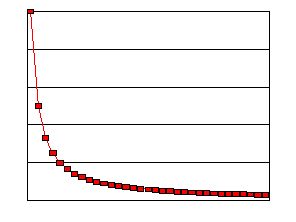 Have you heard of the 'long tail'. It traces back to statistical graphs and generally refers to the impact of the internet. Say that you graph the sale of all books in print from the most popular to the least. The bestsellers would start the graph with high sales. Then would come books with fewer sales, gradually moving into the area of books that interest only a few people. The internet has made it more possible and profitable to market to the niche interest groups out on the 'tail'.
Graphing blogs by popularity would give a long tail indeed. The most popular blogs get thousands of hits every day. Others get hundred of hits. Way out on the tail are the millions of blogs that get only a few daily hits. That's where this blog falls. Welcome to the long tail.
How many blogs do you follow? I have around 30 bookmarked. I probably most often check the ones with the least amount of traffic because those are the ones belonging to people I actually know.
It's an interesting world.
There are a lot of good blogs out there. Published authors have blogs. Celebrities have blogs. Editors have blogs. And millions of ordinary people have blogs. There are around 55 million blogs by one count.
I've seen a definition of 'active' for blogs as having been updated in the past month. I guess that makes this an active blog.
55 million. That's an astounding number of blogs. Many of them are inactive, however. How many people read the average active blog? This blog gets around 7 hits a day, down from 13 when my post on front porches was sometimes the #2 hit on an MSN search for that phrase. About half the hits are still on that one post, mostly coming off Yahoo searches. That still leaves a few of you every day who come here intentionally rather than off the search engines.
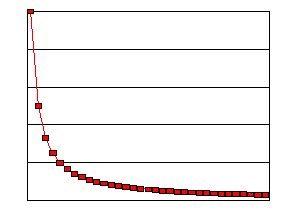 Have you heard of the 'long tail'. It traces back to statistical graphs and generally refers to the impact of the internet. Say that you graph the sale of all books in print from the most popular to the least. The bestsellers would start the graph with high sales. Then would come books with fewer sales, gradually moving into the area of books that interest only a few people. The internet has made it more possible and profitable to market to the niche interest groups out on the 'tail'.
Graphing blogs by popularity would give a long tail indeed. The most popular blogs get thousands of hits every day. Others get hundred of hits. Way out on the tail are the millions of blogs that get only a few daily hits. That's where this blog falls. Welcome to the long tail.
How many blogs do you follow? I have around 30 bookmarked. I probably most often check the ones with the least amount of traffic because those are the ones belonging to people I actually know.
It's an interesting world.
Tuesday, November 28, 2006
Still on the Lam
It has been 30 days since the federal government’s mandate, prompted by the Indiana state legislature and county officials, that I change my clocks to Central Standard Time. I have not done so. I keep an eye out for the clock police, but thus far they have not found me. I’ve carefully checked the distance from my home to the demarcation line between the Central and Eastern time zones - three miles. If government officials start to close in on me I may have to make a run for it.
Our household is divided. The clock on my nightstand is on Eastern time; that on my husband’s side of the bed is on Central. When my radio alarm comes on at 6:28 a.m., his clock reads 5:28 a.m. As does the clock in the livingroom, the bathroom, and the stove and microwave clocks in the kitchen. However, the vehicles and computers, as well as my watch, remain on Eastern time. Since he flies out of an airport in the Eastern time zone more weeks than not, he doesn’t complain.
When I announced that I was refusing to change from Eastern Standard Time after over 30 years of not changing my clocks, I didn’t think I would last this long. How confusing it would be to look at my watch and have it consistently read an hour later than that of my neighbors. I would show up early for appointments and be in a constant state of confusion. It actually has worked out better than I expected. In fact, I rather like it.
Morning is my best time of the day. It’s when I do my serious reading. It’s when I’m most motivated to do housework. I don’t like events that compete for my mornings. Being on “fast time” moves my entire schedule later in the morning. Instead of 9:00 tomorrow morning, it will be 10:00 when the library opens. I like that. Instead of 9:30 on Sunday morning, Sunday School now starts at 10:30. Of course, this carries through the entire day, making evening activities also start an hour later. 7:00 meetings are now at 8:00, well past dark. Which is the problem in the first place. We should not be in the Central time zone. Sunset today was at 4:27 Central time. Every evening activity occurs well after dark. When our government leaders decided we should move to the Central time zone for political reasons, they did not take the additional step of delaying the rising and setting of the sun so that daylight would begin and end at the proper time.
This is why I’m still on Eastern time. There’s not a lot of daylight this time of the year. Less than 10 hours a day. I’d like to enjoy all we get. The way to do that is to start my day before the sun does. Sunrise was at 6:43 Central time this morning. My alarm goes off at 6:28. By making it 6:28 Eastern time (5:28 Central), I’m awake at least an hour before sunrise rather than just a few minutes.
Of course, I could always change my clock to Central time and simply set my alarm for 5:28 instead of 6:28 in order to wake up at the same time. Ah, but then we get to the power of the clock. If our clocks didn’t have power, daylight savings time would have never lasted as long as it has. After all, we could all simply rise an hour earlier in the summer and adjust our bedtime accordingly in order to take advantage of the early sunrise. But the only way we’ll actually do that is if the government makes us change our clocks so that we think we’re still getting up at the same time while actually rising an hour earlier.
My radio comes on at 6:28 but it seldom wakes me. I typically wake up at 6:00 or even earlier. Out of consideration for my husband I try not to turn on the light on my side of the bed before 6:30, but am not adverse to using a little book light to start my morning reading any time after 5:00. I consider 5:00 to be the beginning of the new day. Any time before that is part of the night. If I put my clock on Central time, I wouldn’t feel the same about starting my day at 4:00 a.m., even though it would be at the same place in the sun cycle as 5:00 Eastern. Likewise, I wouldn’t feel the same about going to sleep at 9:30 Central as I do about calling it quits at 10:30 Eastern.
A petition is on file with the Department of Transportation asking that five counties in Indiana be returned to the Eastern time zone. No official action has been taken on that request as of yet. It’s looking like it might be spring before the final decision is made and put into effect. Will I be able to hold out? Maybe. Maybe not.
Yesterday afternoon I ventured across the county line into the Eastern time zone. It was a bit of a shock to realize when I entered a city at 5:00 that it truly was 5:00 there, that everyone else’s watches read the same as mine as they headed home from work. That could take some adjustment. Being out of step does have advantages.
Our household is divided. The clock on my nightstand is on Eastern time; that on my husband’s side of the bed is on Central. When my radio alarm comes on at 6:28 a.m., his clock reads 5:28 a.m. As does the clock in the livingroom, the bathroom, and the stove and microwave clocks in the kitchen. However, the vehicles and computers, as well as my watch, remain on Eastern time. Since he flies out of an airport in the Eastern time zone more weeks than not, he doesn’t complain.
When I announced that I was refusing to change from Eastern Standard Time after over 30 years of not changing my clocks, I didn’t think I would last this long. How confusing it would be to look at my watch and have it consistently read an hour later than that of my neighbors. I would show up early for appointments and be in a constant state of confusion. It actually has worked out better than I expected. In fact, I rather like it.
Morning is my best time of the day. It’s when I do my serious reading. It’s when I’m most motivated to do housework. I don’t like events that compete for my mornings. Being on “fast time” moves my entire schedule later in the morning. Instead of 9:00 tomorrow morning, it will be 10:00 when the library opens. I like that. Instead of 9:30 on Sunday morning, Sunday School now starts at 10:30. Of course, this carries through the entire day, making evening activities also start an hour later. 7:00 meetings are now at 8:00, well past dark. Which is the problem in the first place. We should not be in the Central time zone. Sunset today was at 4:27 Central time. Every evening activity occurs well after dark. When our government leaders decided we should move to the Central time zone for political reasons, they did not take the additional step of delaying the rising and setting of the sun so that daylight would begin and end at the proper time.
This is why I’m still on Eastern time. There’s not a lot of daylight this time of the year. Less than 10 hours a day. I’d like to enjoy all we get. The way to do that is to start my day before the sun does. Sunrise was at 6:43 Central time this morning. My alarm goes off at 6:28. By making it 6:28 Eastern time (5:28 Central), I’m awake at least an hour before sunrise rather than just a few minutes.
Of course, I could always change my clock to Central time and simply set my alarm for 5:28 instead of 6:28 in order to wake up at the same time. Ah, but then we get to the power of the clock. If our clocks didn’t have power, daylight savings time would have never lasted as long as it has. After all, we could all simply rise an hour earlier in the summer and adjust our bedtime accordingly in order to take advantage of the early sunrise. But the only way we’ll actually do that is if the government makes us change our clocks so that we think we’re still getting up at the same time while actually rising an hour earlier.
My radio comes on at 6:28 but it seldom wakes me. I typically wake up at 6:00 or even earlier. Out of consideration for my husband I try not to turn on the light on my side of the bed before 6:30, but am not adverse to using a little book light to start my morning reading any time after 5:00. I consider 5:00 to be the beginning of the new day. Any time before that is part of the night. If I put my clock on Central time, I wouldn’t feel the same about starting my day at 4:00 a.m., even though it would be at the same place in the sun cycle as 5:00 Eastern. Likewise, I wouldn’t feel the same about going to sleep at 9:30 Central as I do about calling it quits at 10:30 Eastern.
A petition is on file with the Department of Transportation asking that five counties in Indiana be returned to the Eastern time zone. No official action has been taken on that request as of yet. It’s looking like it might be spring before the final decision is made and put into effect. Will I be able to hold out? Maybe. Maybe not.
Yesterday afternoon I ventured across the county line into the Eastern time zone. It was a bit of a shock to realize when I entered a city at 5:00 that it truly was 5:00 there, that everyone else’s watches read the same as mine as they headed home from work. That could take some adjustment. Being out of step does have advantages.
Saturday, November 18, 2006
Holocaust
I am a librarian. There are many facets to library work. One job that I don't do well is shelving books. That's because I get distracted by books that are not in their proper place on the shelf and end up sorting books rather than finishing the shelving job. That's not generally a problem because a high school student comes in twice a week to do the reshelving job. However, a couple of weeks ago, as part of another project, I had taken "new" stickers off books that were no longer new and decided to make sure there was room for them on the regular shelves. I discovered another reason why I don't do well at shelving books. I ended up checking two of them out.
The first book I checked out was Night by Elie Wiesel. I hadn't read it and didn't know what it was about; he won the Nobel Peace Prize; it was a thin paperback; it seemed like one of those books that a librarian oughtta read. Preferring to let an author deliver his/her material to me without prior prejudice from reviews or descriptions, I didn't read the cover to find out what I would encounter within the pages.
The second book was Man's Search for Meaning by Viktor Frankl, another thin paperback. This one grabbed my eye because of Stephen Covey's reference to Frankl's writings in The 7 Habits of Highly Effective People. I knew that Frankl had based his theories on self-observation in WWII concentration camps.
Of course, if you keep up on Nobel Peace prize winners or good literature or Oprah's book choices, you will know that I took home not one but two books about life in the concentration camps. I finished Wiesel's book in a week and finished the narrative part of Frankl's book last evening and started in on the conclusions he drew from his experience.
Two weeks of ending most days by reading about one of the most terrible demonstrations in all of history of the cruelty of mankind. Not exactly what I had in mind when I put those two books in my bag instead of on the shelf, but certainly a worthy addition to my "books I've read" list.
Meanwhile, I also completed Organic Church by Neil Cole. It didn't come from the library, but off my recommendations list at Amazon because it fits in with my typical book selections. In this book, Cole told the story of "Schindler's List". Being hypersensitive to film drama and disenamored with television and movies in general, watching a movie such as "Schindler's List" isn't in the competition at all as something I'd enjoy doing. However, I think it may finally be time. I've been slogging through the Holocaust anyway. If I'm ever going to watch this powerful film, now is probably the time. I think. Maybe. But not yet. I'll finish the Frankl book first and then think about it.
The first book I checked out was Night by Elie Wiesel. I hadn't read it and didn't know what it was about; he won the Nobel Peace Prize; it was a thin paperback; it seemed like one of those books that a librarian oughtta read. Preferring to let an author deliver his/her material to me without prior prejudice from reviews or descriptions, I didn't read the cover to find out what I would encounter within the pages.
The second book was Man's Search for Meaning by Viktor Frankl, another thin paperback. This one grabbed my eye because of Stephen Covey's reference to Frankl's writings in The 7 Habits of Highly Effective People. I knew that Frankl had based his theories on self-observation in WWII concentration camps.
Of course, if you keep up on Nobel Peace prize winners or good literature or Oprah's book choices, you will know that I took home not one but two books about life in the concentration camps. I finished Wiesel's book in a week and finished the narrative part of Frankl's book last evening and started in on the conclusions he drew from his experience.
Two weeks of ending most days by reading about one of the most terrible demonstrations in all of history of the cruelty of mankind. Not exactly what I had in mind when I put those two books in my bag instead of on the shelf, but certainly a worthy addition to my "books I've read" list.
Meanwhile, I also completed Organic Church by Neil Cole. It didn't come from the library, but off my recommendations list at Amazon because it fits in with my typical book selections. In this book, Cole told the story of "Schindler's List". Being hypersensitive to film drama and disenamored with television and movies in general, watching a movie such as "Schindler's List" isn't in the competition at all as something I'd enjoy doing. However, I think it may finally be time. I've been slogging through the Holocaust anyway. If I'm ever going to watch this powerful film, now is probably the time. I think. Maybe. But not yet. I'll finish the Frankl book first and then think about it.
Friday, November 10, 2006
Research
The internet has had a huge impact on research. I have an incredible collection of facts and figures and information of all kinds at my fingertips. If I want to mention the world population, I can get an instantaneous estimate. If I want to share a song that is special to me, I can find the lyrics and copy them here. If I want to comment on last week’s news, I can pull up countless reports and related trivia. If I’m not sure I’m spelling or using a word correctly, I can go digging for it in either my word processor or in an online dictionary.
Having information so accessible doesn’t make gathering it instantaneous. Nor does the internet contain the resources to make certain everything I want to say is factual. For example, a couple of weeks ago I wrote a short news release for the local newspaper about the historical collection of that newspaper at the library. I wanted to include the dates of the collection. As far as I know I was the first to publish those dates. Thus, I had to make a trip to the library and check and record the dates before I could finish the article.
Sometimes one can write around missing facts. “The library has an extensive collection of this newspaper on microfilm.” “The more than 6 billion people in the world ...” Other times, doing the required research is the only way to produce good writing. This can be quite annoying when one has time to either write or do the research but not both. When is it better to write around missing facts and when is it better to gather the information now and schedule another time to finish the writing project? If that project is part of an ongoing discussion, will what I want to write still be relevant when I return to the project?
We have an incredible amount of information at our fingertips, which makes tossing around unverified information and ignoring readily-available standards less excusable than ever before. I’m sure that’s a good thing. It is also rather annoying.
Having information so accessible doesn’t make gathering it instantaneous. Nor does the internet contain the resources to make certain everything I want to say is factual. For example, a couple of weeks ago I wrote a short news release for the local newspaper about the historical collection of that newspaper at the library. I wanted to include the dates of the collection. As far as I know I was the first to publish those dates. Thus, I had to make a trip to the library and check and record the dates before I could finish the article.
Sometimes one can write around missing facts. “The library has an extensive collection of this newspaper on microfilm.” “The more than 6 billion people in the world ...” Other times, doing the required research is the only way to produce good writing. This can be quite annoying when one has time to either write or do the research but not both. When is it better to write around missing facts and when is it better to gather the information now and schedule another time to finish the writing project? If that project is part of an ongoing discussion, will what I want to write still be relevant when I return to the project?
We have an incredible amount of information at our fingertips, which makes tossing around unverified information and ignoring readily-available standards less excusable than ever before. I’m sure that’s a good thing. It is also rather annoying.
Sunday, October 29, 2006
Reading report
Anyone paying attention to the list of "What’s in My Bookbag" to the left of this post would think that either a) I am a very slow reader or b) I’m too lazy to update the list on a regular basis. Either option contains some truth. It’s not so much that I read individual pages slowly, but I do tend to read individual books slowly because I don’t read enough pages on any given day to make good progress in all of the books (and magazines) vying for my attention. And I don’t take time to update the list.
Nevertheless, I have actually read two books in the past two weeks. One was on loan from a library and needed to be completed and returned – Embracing Grace: A Gospel for All of Us by Scot McKnight; the other one I found abandoned in my daughter’s room – Messy Spirituality by Michael Yaconelli.
These books have similarities. In fact, McKnight references Yaconelli’s book in his, along with several other of my favorite authors. Much of my reading is in books from the "emergent church" community, placing Christianity in a postmodern setting.
So why do I keep reading authors who are quoting each other and saying similar things? Why saturate myself with such writing? The answer is "balance".
Many of my core beliefs are out of step with those of the community in which I live and worship. When I choke on theology that is being fed to me by people around me, there are few if any who comprehend the difficulty I have in swallowing what is being said. I’m left feeling isolated and lonely. That’s where the books come in. They give me another faith community where voices of authority affirm what I discover in the Word of God and those discoveries are fleshed out with articulate words. It’s not the same as having a local church, however.
On one side, I have people who truly care about me and will come see me in the hospital and show me love but who teach and preach Christianity in ways that offend me. On the other side, I have people who write books that speak to where I am theologically, but who don’t know that I exist and certainly don’t want to hear about my hospital stay.
In the natural balance of things, the people who care about me and with whom I interact face to face have more influence in what they say. Their words easily get under my skin and stir up my defenses. It takes frequent, almost daily, exposure to the writing of people who never enter my world to offset half an hour a couple of times a week of listening to a flesh-and-blood person speak words that drive me crazy.
If I can dig in deep enough, I can fully identify with people like McKnight and Yaconelli and view local voices as merely providing a quaint glimpse into a fading religious culture. Reading the Bible helps. That’s primarily what put me out of step with the fading culture in the first place.
How grateful I am for those who write the books I read. And for those who discover those books and recommend them to me, including the people at amazon.com. And for the resources to get them off my recommended reading list and into my bookbag. I am blessed.
Nevertheless, I have actually read two books in the past two weeks. One was on loan from a library and needed to be completed and returned – Embracing Grace: A Gospel for All of Us by Scot McKnight; the other one I found abandoned in my daughter’s room – Messy Spirituality by Michael Yaconelli.
These books have similarities. In fact, McKnight references Yaconelli’s book in his, along with several other of my favorite authors. Much of my reading is in books from the "emergent church" community, placing Christianity in a postmodern setting.
So why do I keep reading authors who are quoting each other and saying similar things? Why saturate myself with such writing? The answer is "balance".
Many of my core beliefs are out of step with those of the community in which I live and worship. When I choke on theology that is being fed to me by people around me, there are few if any who comprehend the difficulty I have in swallowing what is being said. I’m left feeling isolated and lonely. That’s where the books come in. They give me another faith community where voices of authority affirm what I discover in the Word of God and those discoveries are fleshed out with articulate words. It’s not the same as having a local church, however.
On one side, I have people who truly care about me and will come see me in the hospital and show me love but who teach and preach Christianity in ways that offend me. On the other side, I have people who write books that speak to where I am theologically, but who don’t know that I exist and certainly don’t want to hear about my hospital stay.
In the natural balance of things, the people who care about me and with whom I interact face to face have more influence in what they say. Their words easily get under my skin and stir up my defenses. It takes frequent, almost daily, exposure to the writing of people who never enter my world to offset half an hour a couple of times a week of listening to a flesh-and-blood person speak words that drive me crazy.
If I can dig in deep enough, I can fully identify with people like McKnight and Yaconelli and view local voices as merely providing a quaint glimpse into a fading religious culture. Reading the Bible helps. That’s primarily what put me out of step with the fading culture in the first place.
How grateful I am for those who write the books I read. And for those who discover those books and recommend them to me, including the people at amazon.com. And for the resources to get them off my recommended reading list and into my bookbag. I am blessed.
Sunday, October 15, 2006
High School Class Reunion
I settled in an area 260 miles from my home town when I graduated from college. That’s far enough to not get back often but close enough to be able to make it to special events such as a high school class reunion every five years. Saturday was our sixth such reunion.
I always look forward to the reunions. I want to go back to the dynamics that left me so intimidated and insecure as a teenager and show off the superior social skills I’ve developed over the years. No longer will I be an awkward outsider looking in, longing to be part of the 'in' group. I’m not that socially inept teenager my classmates once knew and dismissed as not worth their notice. I’ve made many friends over the years and am generally comfortable in group settings.
Saturday brought an interesting revelation to me. I’m still on the outside in that group. So much has changed and yet nothing has changed. Those who were obviously developing good social skills all those years ago have continued to develop them. They make the effort required to interact with me for a few moments, chatting with someone whom they’ve never known well and haven’t missed over the years. I wasn’t part of their world then; I’m still not part of their world. They didn’t notice me then; we have few shared memories to discuss now. But they demonstrate their own social skills by taking time to chat with me.
Those who didn’t bother to interact with people they didn’t find interesting all those years ago still find me dull and uninteresting today. They know almost nothing about me as a person and have no interest in getting to know me. They’re not sure why I’m there. After all, I have no part in their favorite memories. They characterize me as a person with little depth. I was 'smart', always messing up the 'curve'. They remember having my father as their 8th-grade math teacher. They don’t remember if I was in a particular class with them. I was just the smart teacher’s kid.
There are exceptions. I have two friends from high school who have gone to extraordinary lengths to keep in touch with me through the years. We get together every year or two. They interact much more often with each other and could easily give up on including me in their activities. What a blessing that they make the effort to contact me. They were at the reunion and it’s always wonderful to see them.
Then there are those whom I don’t remember well who have turned out to be people I could get to know and like given the opportunity. They seem content to interact outside the 'in' group.
How does that group so easily take me back to the old dynamics? I want to talk about myself rather than about them, to prove that I’m a person of value, that there’s more to who and what I am than 'smart', that 'smart' doesn’t even come close to capturing the essence of my being. That compulsion to prove myself worthy of their notice, of course, only makes things worse. I’m back to being the kid who knows all the answers on the test but has no social skills and isn’t worthy of their time.
Back home today, reentering the central time zone allowed us to be only a little late for an afternoon church picnic. I was back on home territory: catching up on the weekend’s events, reporting on our trip, making a note of an appointment for tomorrow afternoon, agreeing to drop off something for someone, hearing good news, greeting people and being greeted, balancing listening with talking, enjoying the group dynamics, My group. People I value and by whom I am valued.
It turns out that being 'in' or 'out' isn’t simply a matter of having good social skills. My classmates decided long ago who was interesting and who was not. The 'not' group is made up of people very much like those with whom I spend all my days. An Amish man whose name I didn’t recognize despite having gone to school with him for eight years found a point of connection with me and provided one of the most interesting exchanges of the day. And, of course, I never tire of interacting with the two friends who keep pulling me back into their company. They are true friends. (They also happen to be 'smart'.)
It’s time to change my expectations for class reunions and focus on those outside the inner circle, the interesting people I never knew who share some of my earliest memories. Even if they never see me as anything beyond 'smart', I can enjoy getting to know them and catching up on their lives every five years as we grow old together. The 'in' crowd always could party quite well without me and still can. It’s time to get to know the rest of the group.
Or maybe it’s time to put the past behind me and enjoy the many interesting people whose paths cross mine every day without having to drive 260 miles.
I always look forward to the reunions. I want to go back to the dynamics that left me so intimidated and insecure as a teenager and show off the superior social skills I’ve developed over the years. No longer will I be an awkward outsider looking in, longing to be part of the 'in' group. I’m not that socially inept teenager my classmates once knew and dismissed as not worth their notice. I’ve made many friends over the years and am generally comfortable in group settings.
Saturday brought an interesting revelation to me. I’m still on the outside in that group. So much has changed and yet nothing has changed. Those who were obviously developing good social skills all those years ago have continued to develop them. They make the effort required to interact with me for a few moments, chatting with someone whom they’ve never known well and haven’t missed over the years. I wasn’t part of their world then; I’m still not part of their world. They didn’t notice me then; we have few shared memories to discuss now. But they demonstrate their own social skills by taking time to chat with me.
Those who didn’t bother to interact with people they didn’t find interesting all those years ago still find me dull and uninteresting today. They know almost nothing about me as a person and have no interest in getting to know me. They’re not sure why I’m there. After all, I have no part in their favorite memories. They characterize me as a person with little depth. I was 'smart', always messing up the 'curve'. They remember having my father as their 8th-grade math teacher. They don’t remember if I was in a particular class with them. I was just the smart teacher’s kid.
There are exceptions. I have two friends from high school who have gone to extraordinary lengths to keep in touch with me through the years. We get together every year or two. They interact much more often with each other and could easily give up on including me in their activities. What a blessing that they make the effort to contact me. They were at the reunion and it’s always wonderful to see them.
Then there are those whom I don’t remember well who have turned out to be people I could get to know and like given the opportunity. They seem content to interact outside the 'in' group.
How does that group so easily take me back to the old dynamics? I want to talk about myself rather than about them, to prove that I’m a person of value, that there’s more to who and what I am than 'smart', that 'smart' doesn’t even come close to capturing the essence of my being. That compulsion to prove myself worthy of their notice, of course, only makes things worse. I’m back to being the kid who knows all the answers on the test but has no social skills and isn’t worthy of their time.
Back home today, reentering the central time zone allowed us to be only a little late for an afternoon church picnic. I was back on home territory: catching up on the weekend’s events, reporting on our trip, making a note of an appointment for tomorrow afternoon, agreeing to drop off something for someone, hearing good news, greeting people and being greeted, balancing listening with talking, enjoying the group dynamics, My group. People I value and by whom I am valued.
It turns out that being 'in' or 'out' isn’t simply a matter of having good social skills. My classmates decided long ago who was interesting and who was not. The 'not' group is made up of people very much like those with whom I spend all my days. An Amish man whose name I didn’t recognize despite having gone to school with him for eight years found a point of connection with me and provided one of the most interesting exchanges of the day. And, of course, I never tire of interacting with the two friends who keep pulling me back into their company. They are true friends. (They also happen to be 'smart'.)
It’s time to change my expectations for class reunions and focus on those outside the inner circle, the interesting people I never knew who share some of my earliest memories. Even if they never see me as anything beyond 'smart', I can enjoy getting to know them and catching up on their lives every five years as we grow old together. The 'in' crowd always could party quite well without me and still can. It’s time to get to know the rest of the group.
Or maybe it’s time to put the past behind me and enjoy the many interesting people whose paths cross mine every day without having to drive 260 miles.
Wednesday, October 04, 2006
On prayer
It turns out that a lot of Americans pray. People who never step into a church or practice intentional religion admit to praying. (I don’t have statistics to support these statements. You’ll have to take my word for it that someone has done the research and the results do indeed reveal widespread prayer.) People believe in the power of prayer.
So if I reveal to you that I’m a closet pray-er* will you want to hang around with me and tell me about your problems so I can pray for you? Will you be part of my church if we tell you that we’ll pray for you and your friends and family?
I participated in a church survey a while back. We were given a series of statements and asked to indicate our level of agreement with each statement, ranging from “strongly disagree” to “strongly agree”. One of the statements was, “Prayer works.”
I left it blank. Works for what? If prayer is speaking to God (the dictionary definition), how do we decide whether it works or not? Does speaking to your boss work? To your parents? To your friends? Does talking, in general, work? If we were asked any of those questions, we would seek clarification. Or at least I would. Speaking to my boss doesn’t generally work for getting my dog fed. Nor does speaking to my friends get me an appointment with my dentist. However, speaking to my boss can help me prioritize my work, and speaking the right kinds of words to my friends helps maintain my relationship with them. Speaking is part of communication (along with listening), and communication does accomplish much. Does that mean that “talking works”?
What was the thinking behind the survey question? What were they really asking? What does it look like when “prayer works”? Were the surveyors assuming that our speaking to God consists primarily of a series of petitions? In that case, I guess that prayer works when our petitions are granted. So does prayer work? If every petition voiced in prayer were granted, there would be much less sickness and pain and death around us. Is there anyone who hasn’t prayed for someone to live and been disappointed when death came? Or that the diagnosis not show cancer and it did? If success in prayer means getting whatever we ask for and being able to create a smooth path for ourselves and everyone we care about, I would have to say that I strongly disagree with the statement “prayer works”.
Does that mean that I don’t believe in the power of prayer? You might decide that based on the above statement. And I wouldn’t debate with you. Although there may be rare exceptions, I’m pretty sure that most of the time, prayer won’t help you win the lottery. Prayer doesn’t work for that.
Still, I pray. Does prayer work? Yes. It works for what I hope to accomplish by praying, which has nothing to do with physical healing, smooth paths, and winning numbers. I pray because I’m changed by prayer and it’s my only hope for making a difference in the lives of those around me. I pray because I have more questions than answers and asking God those questions gives me insights that I would never have on my own. (Which generally lead to more questions.)
You may not want me to pray for you (although if you’re someone I know, there’s a good chance you’ve been in my prayers already). I’m not likely to ask God to give you smooth sailing and to remove every obstacle in your path. After all, it’s the tough times that help us to grow.** I’m as likely to ask God to grant you strength to endure the pain that has come your way as to ask that He take away the pain. I will pray that you find blessing in the thorns, that you reach the point where you can look back on the tough times and say, “It was intended as evil, but it all worked out for good.”*** I will pray that God will draw up close to you and allow you to sense His calming presence in the midst of the storms you face. I might even mention to our heavenly Father that it seems that you could use some clear skies now and then, although I would probably stop short of actually requesting a break in the storm.
I wonder. Would you be disappointed if I prayed for you that way?
-----------------
Loose Bible connections for anyone who is interested.
* Matthew 6:6
** Romans 5:3-4
*** Genesis 50:20
So if I reveal to you that I’m a closet pray-er* will you want to hang around with me and tell me about your problems so I can pray for you? Will you be part of my church if we tell you that we’ll pray for you and your friends and family?
I participated in a church survey a while back. We were given a series of statements and asked to indicate our level of agreement with each statement, ranging from “strongly disagree” to “strongly agree”. One of the statements was, “Prayer works.”
I left it blank. Works for what? If prayer is speaking to God (the dictionary definition), how do we decide whether it works or not? Does speaking to your boss work? To your parents? To your friends? Does talking, in general, work? If we were asked any of those questions, we would seek clarification. Or at least I would. Speaking to my boss doesn’t generally work for getting my dog fed. Nor does speaking to my friends get me an appointment with my dentist. However, speaking to my boss can help me prioritize my work, and speaking the right kinds of words to my friends helps maintain my relationship with them. Speaking is part of communication (along with listening), and communication does accomplish much. Does that mean that “talking works”?
What was the thinking behind the survey question? What were they really asking? What does it look like when “prayer works”? Were the surveyors assuming that our speaking to God consists primarily of a series of petitions? In that case, I guess that prayer works when our petitions are granted. So does prayer work? If every petition voiced in prayer were granted, there would be much less sickness and pain and death around us. Is there anyone who hasn’t prayed for someone to live and been disappointed when death came? Or that the diagnosis not show cancer and it did? If success in prayer means getting whatever we ask for and being able to create a smooth path for ourselves and everyone we care about, I would have to say that I strongly disagree with the statement “prayer works”.
Does that mean that I don’t believe in the power of prayer? You might decide that based on the above statement. And I wouldn’t debate with you. Although there may be rare exceptions, I’m pretty sure that most of the time, prayer won’t help you win the lottery. Prayer doesn’t work for that.
Still, I pray. Does prayer work? Yes. It works for what I hope to accomplish by praying, which has nothing to do with physical healing, smooth paths, and winning numbers. I pray because I’m changed by prayer and it’s my only hope for making a difference in the lives of those around me. I pray because I have more questions than answers and asking God those questions gives me insights that I would never have on my own. (Which generally lead to more questions.)
You may not want me to pray for you (although if you’re someone I know, there’s a good chance you’ve been in my prayers already). I’m not likely to ask God to give you smooth sailing and to remove every obstacle in your path. After all, it’s the tough times that help us to grow.** I’m as likely to ask God to grant you strength to endure the pain that has come your way as to ask that He take away the pain. I will pray that you find blessing in the thorns, that you reach the point where you can look back on the tough times and say, “It was intended as evil, but it all worked out for good.”*** I will pray that God will draw up close to you and allow you to sense His calming presence in the midst of the storms you face. I might even mention to our heavenly Father that it seems that you could use some clear skies now and then, although I would probably stop short of actually requesting a break in the storm.
I wonder. Would you be disappointed if I prayed for you that way?
-----------------
Loose Bible connections for anyone who is interested.
* Matthew 6:6
** Romans 5:3-4
*** Genesis 50:20
Sunday, October 01, 2006
Church – homogenous or diverse
I read an interesting report in the October issue of Christianity Today. (I’m far, far behind on my reading and CT shows up with 154 pages for their 50th anniversary issue!) It seems Willow Creek Community Church has discontinued their “church-within-a-church” for 20-somethings. Attendance had dropped from 2,000 to around 350. Apparently, a program that attracts so few people is considered non-sustainable by Willow Creek standards. Ironically, there are few congregations around here with that many in their entire congregation and most have far less, but that’s not what I want to talk about.
The problem, according to the report, was that the group was isolated from the rest of the congregation. Among other results of this isolation, when young adults outgrew that group they found it difficult to make the transition into the larger congregation. Also, some of the elements that were distinctive to the young adult ministry were adopted by the church as a whole, lessening the need for having a separate group.
I find it depressing to imagine being part of a large church group that includes no one outside a 10-year age span – no children to amuse me, no one from my parents’ generation to put an arm around my shoulders, no teenagers with their boundless enthusiasm and energy. I think I can understand why this format didn’t last at Willow Creek.
I’m reminded of my “It’s not about you” post from a few months ago. I commented that the church is ALL about the people of whom it is composed. Tightening the age-span of those people enables the church to make it all about that one demographic rather than finding ways to minister to a more diverse group. I’m not sure that’s a positive thing. Rather, when we plan for and accommodate diversity, including age diversity, it broadens the horizons of all involved. Young people can find mentors and positive examples among the older adults. They can find places of service using the skills that they have at a particular time and place in their lives. I much prefer the picture of the church as family - children, teens, parents, grandparents, aunts, uncles, siblings, cousins from Duluth, etc - to that of a college dormitory.
I’m glad that Willow Creek tried this “church-within-a-church” concept and someone reported the results. It increases my commitment to championing ministry designed for people of all ages. It’s all about the children and the senior adults and the young adults and the teenagers. It’s all about the old-timers and the newbies, those who know the ropes and those who don’t. They’re all part of the family and each needs to be given full consideration. There’s a place for activities that appeal to one grouping within the church more than others, but there’s also great value in making sure there’s something for everyone in the large family gatherings and that those gatherings occur frequently. Family is not just for those fortunate enough to be born into one that stays together for a lifetime.
The problem, according to the report, was that the group was isolated from the rest of the congregation. Among other results of this isolation, when young adults outgrew that group they found it difficult to make the transition into the larger congregation. Also, some of the elements that were distinctive to the young adult ministry were adopted by the church as a whole, lessening the need for having a separate group.
I find it depressing to imagine being part of a large church group that includes no one outside a 10-year age span – no children to amuse me, no one from my parents’ generation to put an arm around my shoulders, no teenagers with their boundless enthusiasm and energy. I think I can understand why this format didn’t last at Willow Creek.
I’m reminded of my “It’s not about you” post from a few months ago. I commented that the church is ALL about the people of whom it is composed. Tightening the age-span of those people enables the church to make it all about that one demographic rather than finding ways to minister to a more diverse group. I’m not sure that’s a positive thing. Rather, when we plan for and accommodate diversity, including age diversity, it broadens the horizons of all involved. Young people can find mentors and positive examples among the older adults. They can find places of service using the skills that they have at a particular time and place in their lives. I much prefer the picture of the church as family - children, teens, parents, grandparents, aunts, uncles, siblings, cousins from Duluth, etc - to that of a college dormitory.
I’m glad that Willow Creek tried this “church-within-a-church” concept and someone reported the results. It increases my commitment to championing ministry designed for people of all ages. It’s all about the children and the senior adults and the young adults and the teenagers. It’s all about the old-timers and the newbies, those who know the ropes and those who don’t. They’re all part of the family and each needs to be given full consideration. There’s a place for activities that appeal to one grouping within the church more than others, but there’s also great value in making sure there’s something for everyone in the large family gatherings and that those gatherings occur frequently. Family is not just for those fortunate enough to be born into one that stays together for a lifetime.
Wednesday, September 20, 2006
Going to church without getting angry -- revisited
Just some thoughts for a certain someone who is struggling with anger in relationship to the church. (And, no, C., none of this is about you.)
I think I've actually made some progress in this area over the past year. One thing I pondered was why I go to church in the first place. None of my primary reasons for being part of a church (fellowship, accountability, and ministry) require that everyone (or even anyone) have the precise same beliefs that I have. As long as I'm finding common ground with the official theologians of the denomination, I figure there's room for diversity in the local congregation. I also pondered some specific strategies for going to church without getting angry. But I think the thing that has helped the most is realizing that it really is God's church, not mine. He hasn't commissioned me to fix the church. The leadership of the church isn't looking to me for advice or guidance. I will not be held responsible when the doors close at the church where I'm a member.
There are almost unlimited ministry opportunities in the church. There are hurting people there who are searching for healing. There are discouraged people looking for hope. There are lonely people looking for friendship. There are hungry people looking for spiritual nurture. Every week these people gather in the church. How many go away disappointed by what happens there? Some of them may even go away angry and wonder if they can keep coming week after week for no more than they're getting out of it. They need someone who will listen to them and offer them words of encouragement. In Exodus chapter 4 the Lord asked Moses what he had in his hand. The answer was a staff. Moses did great things with that staff. Even when it seems I have far too little influence, there's always something in my hand that can be used to minister to hurting people.
The church is full of imperfect people with various goals and purposes, noble and not-so-noble. Some of those not-so-noble goals cause pain. Which translates into more ministry opportunities.
The humbling part is that I am one of the imperfect people. My goals and purposes are not always so noble as I wish they were. I cause pain, sometimes without even realizing it, other times knowing it's happening but powerless to stop it. It's in the rough-and-tumble of church life that I can find both good examples to emulate and bad examples that help me know what to seek to eliminate from my own life. At my best, I'm a missionary bringing the culture of the kingdom of God into a place that claims to know it well but barely recognizes the real thing. At my worst, I need to hear the message of grace and forgiveness and an invitation to do better.
The church may not speak that message so clearly as it ought, but there are always at least a few who demonstrate the truth of that message. I'd like to more often be among those few and be yeast permeating the entire batch of dough. What better place to find dough to permeate than the church? The message of grace is as wanted and needed there as anywhere. When I extend grace to the imperfect people running the church in imperfect ways without inviting me to share my wisdom with them and when I focus on the many needs of those around me, I find that I can go to church without getting angry.
Most of the time.
I think I've actually made some progress in this area over the past year. One thing I pondered was why I go to church in the first place. None of my primary reasons for being part of a church (fellowship, accountability, and ministry) require that everyone (or even anyone) have the precise same beliefs that I have. As long as I'm finding common ground with the official theologians of the denomination, I figure there's room for diversity in the local congregation. I also pondered some specific strategies for going to church without getting angry. But I think the thing that has helped the most is realizing that it really is God's church, not mine. He hasn't commissioned me to fix the church. The leadership of the church isn't looking to me for advice or guidance. I will not be held responsible when the doors close at the church where I'm a member.
There are almost unlimited ministry opportunities in the church. There are hurting people there who are searching for healing. There are discouraged people looking for hope. There are lonely people looking for friendship. There are hungry people looking for spiritual nurture. Every week these people gather in the church. How many go away disappointed by what happens there? Some of them may even go away angry and wonder if they can keep coming week after week for no more than they're getting out of it. They need someone who will listen to them and offer them words of encouragement. In Exodus chapter 4 the Lord asked Moses what he had in his hand. The answer was a staff. Moses did great things with that staff. Even when it seems I have far too little influence, there's always something in my hand that can be used to minister to hurting people.
The church is full of imperfect people with various goals and purposes, noble and not-so-noble. Some of those not-so-noble goals cause pain. Which translates into more ministry opportunities.
The humbling part is that I am one of the imperfect people. My goals and purposes are not always so noble as I wish they were. I cause pain, sometimes without even realizing it, other times knowing it's happening but powerless to stop it. It's in the rough-and-tumble of church life that I can find both good examples to emulate and bad examples that help me know what to seek to eliminate from my own life. At my best, I'm a missionary bringing the culture of the kingdom of God into a place that claims to know it well but barely recognizes the real thing. At my worst, I need to hear the message of grace and forgiveness and an invitation to do better.
The church may not speak that message so clearly as it ought, but there are always at least a few who demonstrate the truth of that message. I'd like to more often be among those few and be yeast permeating the entire batch of dough. What better place to find dough to permeate than the church? The message of grace is as wanted and needed there as anywhere. When I extend grace to the imperfect people running the church in imperfect ways without inviting me to share my wisdom with them and when I focus on the many needs of those around me, I find that I can go to church without getting angry.
Most of the time.
Wednesday, September 13, 2006
On being a layperson
A conjunction of various discussions has given me a new awareness of how theologically freeing it is to be a layperson in the church. That’s assuming that you choose to be part of organized religion. If you do, I recommend lay ministry over vocational ministry.
Some have pointed out to me that those who are called to vocational ministry assume a higher level of responsibility when they accept the ordination of the church. As a member of a denomination which encourages every member to dedicate their entire being to being a disciple of Jesus Christ, this puzzles me. Aren’t we all responsible to devote our whole selves to ministry whether it’s our vocation or not? Am I any less responsible to demonstrate and promote the values of the kingdom of God in a secular job than within the church walls?
As I’ve considered this and observed those in full-time ministry, it has occurred to me that the extra responsibility is not so much to God as it is to the church. The minister is the face of the church. Ordination charges a person to represent the church at all times.
Not only does this sometimes result in significant pressure to meet higher ethical and behavioral standards, it also draws a box around a person’s theology. Here is what the church believes. Thus, this is what you will believe – and teach and preach. To question the beliefs of the church would be to cause schism within the organization.
As a layperson in the church, my level of commitment to doing the will of God 24/7 is no less, but my level of commitment to the church itself is whatever I choose to make it. Anyone who looks to me as a spokesperson for the church is looking in the wrong place. If my pastor’s theology is weird, there’s a problem in my church. If my theology is weird, I’m just a confused layperson with no authority to speak for the church.
I participate in a forum that often has discussions of theological issues. I find it interesting that people often post theological questions and address them to the many pastors who participate on the forum. However, it’s usually laypeople who compose the bulk of the responses. Perhaps that’s because pastors are busy people and don’t have time to discuss silly theological questions being asked on the internet. Or perhaps it’s because the discussion involves accepted beliefs of the denomination and pastors feel obligated to stick to the “company line”. If there’s only one acceptable answer to a question, it doesn’t make for a very interesting discussion. It takes a brave person to think independently while depending for his or her livelihood on an organization that likes to draw boxes around people's thinking.
As a layperson, I can set my faith aside entirely and impact only those who have mistakenly allowed me to represent God and the church to them and whom I tell about my faith crisis. If it is a prolonged crisis, I may need to set aside formal ministry for a while. I may question basic beliefs of the congregation of which I am a part. Doing so will endanger neither my livelihood nor the integrity of the church. If it’s a mild crisis, I can simply keep my mouth shut when discussions in the area of doubt arise.
I don’t have to know the answers. I don’t have to toe the line. I don’t have to be right. I simply need to love the Lord my God with all my heart, soul, mind, and strength – and my neighbor as myself. And act on that love.
You see? This faith stuff is as simple as 1-2-3 so long as you stay out of vocational ministry.
Some have pointed out to me that those who are called to vocational ministry assume a higher level of responsibility when they accept the ordination of the church. As a member of a denomination which encourages every member to dedicate their entire being to being a disciple of Jesus Christ, this puzzles me. Aren’t we all responsible to devote our whole selves to ministry whether it’s our vocation or not? Am I any less responsible to demonstrate and promote the values of the kingdom of God in a secular job than within the church walls?
As I’ve considered this and observed those in full-time ministry, it has occurred to me that the extra responsibility is not so much to God as it is to the church. The minister is the face of the church. Ordination charges a person to represent the church at all times.
Not only does this sometimes result in significant pressure to meet higher ethical and behavioral standards, it also draws a box around a person’s theology. Here is what the church believes. Thus, this is what you will believe – and teach and preach. To question the beliefs of the church would be to cause schism within the organization.
As a layperson in the church, my level of commitment to doing the will of God 24/7 is no less, but my level of commitment to the church itself is whatever I choose to make it. Anyone who looks to me as a spokesperson for the church is looking in the wrong place. If my pastor’s theology is weird, there’s a problem in my church. If my theology is weird, I’m just a confused layperson with no authority to speak for the church.
I participate in a forum that often has discussions of theological issues. I find it interesting that people often post theological questions and address them to the many pastors who participate on the forum. However, it’s usually laypeople who compose the bulk of the responses. Perhaps that’s because pastors are busy people and don’t have time to discuss silly theological questions being asked on the internet. Or perhaps it’s because the discussion involves accepted beliefs of the denomination and pastors feel obligated to stick to the “company line”. If there’s only one acceptable answer to a question, it doesn’t make for a very interesting discussion. It takes a brave person to think independently while depending for his or her livelihood on an organization that likes to draw boxes around people's thinking.
As a layperson, I can set my faith aside entirely and impact only those who have mistakenly allowed me to represent God and the church to them and whom I tell about my faith crisis. If it is a prolonged crisis, I may need to set aside formal ministry for a while. I may question basic beliefs of the congregation of which I am a part. Doing so will endanger neither my livelihood nor the integrity of the church. If it’s a mild crisis, I can simply keep my mouth shut when discussions in the area of doubt arise.
I don’t have to know the answers. I don’t have to toe the line. I don’t have to be right. I simply need to love the Lord my God with all my heart, soul, mind, and strength – and my neighbor as myself. And act on that love.
You see? This faith stuff is as simple as 1-2-3 so long as you stay out of vocational ministry.
Wednesday, September 06, 2006
What I'm reading
I started reading at an early age and jumped quickly into voracious reading. I remember reading all the Oz books in the bookmobile because the editions found there fit into a scarce category of books long enough to last me for a while but with the large print needed for my immature eyes. I couldn't handle the small print that was generally used for books at my reading level.
I don't know when I moved on to small print, but I think it was still in my early years that I discovered the Lone Ranger -- not more than 3rd grade, I imagine. I don't know what it was about the Lone Ranger that attracted me but I devoured that row of books in the bookmobile. They were old even then. Many had little "treasure hunts" scribbled onto their pages, i.e. "go to page 45" and on page 45, "go to page 110" and so on until one would finally arrive at a "you are here" message. There were a smattering of black marks where someone had thoughtfully crossed out bad words to protect innocent young eyes like mine.
As far as I can remember, no one ever told me that the Lone Ranger was a radio character before riding into the series of books about him. I thought the books contained everything there was to know about him and Tonto.
As I matured and became more discerning in my reading, I discovered that one can often tell when a book is based on a television show or movie. The storyline depends more on dialog and action than inner observations and the characters, having lost the body language they could convey on screen without picking up a well-developed thought life, tend to be rather flat.
I've sometimes wondered about the Lone Ranger books. Did they fall into that category? Would I laugh at my childish attraction to them if I went back to them as an adult? But alas, whatever else was true about them, the Lone Ranger books did not survive the test of time to become classics. They faded out of print and off library shelves. I moved away from my beloved bookmobile, which has likewise disappeared off the streets of my hometown, and there were no more Lone Ranger books in my life. Nor large-print Oz books, for that matter.
A couple of weeks ago someone clearing out their personal library in preparation for a move donated several boxes of books to the public library. I glanced through them to see if there was anything that should be added to the library collection rather than being set aside for the next book sale. And there it was -- The Lone Ranger by Fran Striker, copyright 1936.
So that's what I'm reading. It's not bad, although quite musty - definitely not for the asthmatic. There's nothing grand about it, just an old western that is now completely politically incorrect, but at least I haven't noticed that "made for television" feel to it. I'm fairly pleased with the taste of the young reader I used to be. I've been dawdling my way through it, but I may have to push to the end tonight and see if they ever got that east-to-west railroad completed.
Hi-yo, Silver, away!
I don't know when I moved on to small print, but I think it was still in my early years that I discovered the Lone Ranger -- not more than 3rd grade, I imagine. I don't know what it was about the Lone Ranger that attracted me but I devoured that row of books in the bookmobile. They were old even then. Many had little "treasure hunts" scribbled onto their pages, i.e. "go to page 45" and on page 45, "go to page 110" and so on until one would finally arrive at a "you are here" message. There were a smattering of black marks where someone had thoughtfully crossed out bad words to protect innocent young eyes like mine.
As far as I can remember, no one ever told me that the Lone Ranger was a radio character before riding into the series of books about him. I thought the books contained everything there was to know about him and Tonto.
As I matured and became more discerning in my reading, I discovered that one can often tell when a book is based on a television show or movie. The storyline depends more on dialog and action than inner observations and the characters, having lost the body language they could convey on screen without picking up a well-developed thought life, tend to be rather flat.
I've sometimes wondered about the Lone Ranger books. Did they fall into that category? Would I laugh at my childish attraction to them if I went back to them as an adult? But alas, whatever else was true about them, the Lone Ranger books did not survive the test of time to become classics. They faded out of print and off library shelves. I moved away from my beloved bookmobile, which has likewise disappeared off the streets of my hometown, and there were no more Lone Ranger books in my life. Nor large-print Oz books, for that matter.
A couple of weeks ago someone clearing out their personal library in preparation for a move donated several boxes of books to the public library. I glanced through them to see if there was anything that should be added to the library collection rather than being set aside for the next book sale. And there it was -- The Lone Ranger by Fran Striker, copyright 1936.
So that's what I'm reading. It's not bad, although quite musty - definitely not for the asthmatic. There's nothing grand about it, just an old western that is now completely politically incorrect, but at least I haven't noticed that "made for television" feel to it. I'm fairly pleased with the taste of the young reader I used to be. I've been dawdling my way through it, but I may have to push to the end tonight and see if they ever got that east-to-west railroad completed.
Hi-yo, Silver, away!
Friday, August 25, 2006
On church fundraising
A story:
There once was a small town by the name of Podunk with a small Church of the Nazarene. Two men named Jason and Fred were members of the Podunk Church of the Nazarene. There were also other members, but not many. The church was small. The offerings were small. The building was old.
And it came to pass that one bright and sunny day, the pastor of the Podunk Church of the Nazarene saw water where no water ought to have been. He looked at the old copper pipes and sent for a professional. The owner of Podunk Heating & Plumbing walked around saying, "Hmm..." and "Ahh..." and "Interesting ..." for a short while which seemed long and then handed the pastor an estimate for $500. The pastor looked in the treasury box. There were only a few coins in the bottom of the box. The pastor reluctantly cranked the water valve shut and waited for Sunday.
Fred and Jason were in church the following Sunday as was their weekly habit. They heard the pastor announce that the water valve was closed until $500 could be collected for repairs. The regular tithes and offerings were barely sufficient for regular expenses. The extra $500 would need to be gained in a way that would not reduce the regular giving. Jason and Fred were sad because they each had only $40 to contribute toward the $500 plumbing repair leaving $420 for their fellow church members, a daunting figure. How could they do more?
And behold, Jason and Fred were friends and had together attended a birdhouse-building workshop at a craft store in Nabrington, a nearby town. They both discovered hidden talents in this area. They talked together and decided that they would make and sell birdhouses and give the money to the fund for the plumbing repair. And so, they each took their $40 on Monday and purchased supplies for 10 birdhouses. With quick yet careful work, they constructed and painted 20 beautiful birdhouses.
"Fred," said Jason. "I propose that we put up a table in the town square with a sign announcing that the proceeds from the birdhouses will be used to repair the plumbing at the Podunk Church of the Nazarene and thus sell them to our friends and neighbors." However, Fred was not in agreement with this proposal and the discussion became so sharp that they parted ways, Jason to put together a birdhouse display on the town square and Fred to take his birdhouses to the craft store in Nabrington where he proposed to the storeowner that the birdhouses be sold for $10 each, with a $1 commission. The storeowner was pleased, for the birdhouses were beautiful. They were thus put on display.
Five customers came to the store on the first day. The first customer looked at the birdhouses and said, "What marvelous birdhouses! But, alas, there is no room in my garden to display such a marvelous creation. I must pass these by."
The second customer looked at the birdhouses and said, "What marvelous birdhouses! But, alas, there is no money in my pocket. I must pass them by."
The third customer looked at the birdhouses and said, "What marvelous birdhouses! However, the $10 in my pocket is for the offering plate at my church. I must pass them by."
The fourth customer looked at the birdhouses and said, "What marvelous birdhouses! I will buy one for my garden." And he did.
The fifth customer looked at the birdhouses and said, "What marvelous birdhouses! I have no place for one but I will buy one for a friend." And he did.
On the second day, the same occurred and on each day thereafter until the last birdhouse was sold. On Saturday afternoon Fred returned to the shop and the shopkeeper placed in his hands $90 for the birdhouses, keeping $10 for commission. He offered space in his store for 10 birdhouses per week if Fred decided to build and sell more.
Meanwhile, Jason set up his display on the Podunk town square with a sign reading, "Please support the plumbing repair at the Podunk Church of the Nazarene."
And people came past. The first passerby said, "What marvelous birdhouses! But, alas, there is no room in my garden to display such a marvelous creation. Still, the Podunk Church of the Nazarene needs repairs and Jason is my friend and neighbor. I will buy one anyway." And he did and put it in storage in his garage where it gathers dust to this day.
The second passerby looked at the birdhouses and said, "What marvelous birdhouses! But, alas, there is no money in my pocket. I am unable to contribute to the plumbing project at the Podunk Church of the Nazarene or to purchase a birdhouse. I must pass them by." And he went away sad because he could not purchase a birdhouse and participate in the fund-raising project.
The third passerby looked at the birdhouses and said, "What marvelous birdhouses! The money in my pocket is for the offering plate at my church. However, I see that the Podunk Church of the Nazarene has a great need. I will buy a birdhouse with the money. It will still go to the work of the Lord and I will be able to carry home one of these marvelous birdhouses."
The fourth passerby looked at the birdhouses and said, "What marvelous birdhouses! I will buy one for my garden." And he did.
The fifth passerby looked at the birdhouses and said, "What marvelous birdhouses! I have no place for one but I will buy one for a friend." And he did.
And in this way, Jason was able to sell birdhouses to 80% of passersby and quickly liquidated his inventory and packed up and went home with $100.
On Sunday, Jason and Fred brought their money and laid it at the feet of the elders. Fred said, "Behold, I took $40 and built 10 birdhouses and sold them on their own merit at the craftshop in Nabrington for a commission. The Lord has blessed me and I am overjoyed that I can now give $90 instead of $40.
Jason said, "Behold, I took $40 and built 10 birdhouses and sold them in the town square to our friends and neighbors whom I asked to help us fix our plumbing problems. By investing only $40, I can now contribute $100 collected from the community.
-------------------------------
Which of these men most blessed his church and community?
To many, there may be no difference. To me, there's a big difference. Fred received the joy of giving his own money multiplied by labor invested. All his profits came from uncoerced, willing buyers in a free market. Jason gave other people's money and collected it by using the church name to persuade community members to take on the needs of the Church of the Nazarene in addition to their own churches. The church became a charity project for the community.
I can see that sometimes having the church name attached to a fund-raiser is less to persuade people to give where they otherwise would not than to give name-recognition to the church in the community. I'm still not comfortable with it, however. It reduces the joy of bringing our tithes and offerings into the storehouse as a personal sacrifice and an act of corporate worship. And some who might have given will be content to let the community meet the needs of the church, rather than the church meeting the needs of the community, thus losing the blessing of giving to both the church and community.
I'm not ever comfortable with fund-raising for the church, but find it less offensive if it is limited to children and youth who have no marketable skills to use to earn money to give to the Lord and who, thus, must depend on the charity of adults either in the church or in the larger community to fund their activities. In those cases, fundraisers can help the child with less financial support at home participate in activities from which he or she would otherwise be excluded. As for the adults:
When a group of Christians come together for worship, fellowship, discipleship, and ministry they are blessed in the pooling of their resources to support the activities of their fellowship. Asking the community to support the needs of that fellowship group poses a significant threat to the health of the church they have formed together – in my opinion.
Since this is my blog, I suppose I'm allowed to express that opinion here. But if you're ever in Podunk, be kind to Jason, all right? He's really a good guy doing his best to support the church. We just have different ideas as to the best approach to doing that.
What do you think? (Feel free to add a comment expressing your own opinion.)
There once was a small town by the name of Podunk with a small Church of the Nazarene. Two men named Jason and Fred were members of the Podunk Church of the Nazarene. There were also other members, but not many. The church was small. The offerings were small. The building was old.
And it came to pass that one bright and sunny day, the pastor of the Podunk Church of the Nazarene saw water where no water ought to have been. He looked at the old copper pipes and sent for a professional. The owner of Podunk Heating & Plumbing walked around saying, "Hmm..." and "Ahh..." and "Interesting ..." for a short while which seemed long and then handed the pastor an estimate for $500. The pastor looked in the treasury box. There were only a few coins in the bottom of the box. The pastor reluctantly cranked the water valve shut and waited for Sunday.
Fred and Jason were in church the following Sunday as was their weekly habit. They heard the pastor announce that the water valve was closed until $500 could be collected for repairs. The regular tithes and offerings were barely sufficient for regular expenses. The extra $500 would need to be gained in a way that would not reduce the regular giving. Jason and Fred were sad because they each had only $40 to contribute toward the $500 plumbing repair leaving $420 for their fellow church members, a daunting figure. How could they do more?
And behold, Jason and Fred were friends and had together attended a birdhouse-building workshop at a craft store in Nabrington, a nearby town. They both discovered hidden talents in this area. They talked together and decided that they would make and sell birdhouses and give the money to the fund for the plumbing repair. And so, they each took their $40 on Monday and purchased supplies for 10 birdhouses. With quick yet careful work, they constructed and painted 20 beautiful birdhouses.
"Fred," said Jason. "I propose that we put up a table in the town square with a sign announcing that the proceeds from the birdhouses will be used to repair the plumbing at the Podunk Church of the Nazarene and thus sell them to our friends and neighbors." However, Fred was not in agreement with this proposal and the discussion became so sharp that they parted ways, Jason to put together a birdhouse display on the town square and Fred to take his birdhouses to the craft store in Nabrington where he proposed to the storeowner that the birdhouses be sold for $10 each, with a $1 commission. The storeowner was pleased, for the birdhouses were beautiful. They were thus put on display.
Five customers came to the store on the first day. The first customer looked at the birdhouses and said, "What marvelous birdhouses! But, alas, there is no room in my garden to display such a marvelous creation. I must pass these by."
The second customer looked at the birdhouses and said, "What marvelous birdhouses! But, alas, there is no money in my pocket. I must pass them by."
The third customer looked at the birdhouses and said, "What marvelous birdhouses! However, the $10 in my pocket is for the offering plate at my church. I must pass them by."
The fourth customer looked at the birdhouses and said, "What marvelous birdhouses! I will buy one for my garden." And he did.
The fifth customer looked at the birdhouses and said, "What marvelous birdhouses! I have no place for one but I will buy one for a friend." And he did.
On the second day, the same occurred and on each day thereafter until the last birdhouse was sold. On Saturday afternoon Fred returned to the shop and the shopkeeper placed in his hands $90 for the birdhouses, keeping $10 for commission. He offered space in his store for 10 birdhouses per week if Fred decided to build and sell more.
Meanwhile, Jason set up his display on the Podunk town square with a sign reading, "Please support the plumbing repair at the Podunk Church of the Nazarene."
And people came past. The first passerby said, "What marvelous birdhouses! But, alas, there is no room in my garden to display such a marvelous creation. Still, the Podunk Church of the Nazarene needs repairs and Jason is my friend and neighbor. I will buy one anyway." And he did and put it in storage in his garage where it gathers dust to this day.
The second passerby looked at the birdhouses and said, "What marvelous birdhouses! But, alas, there is no money in my pocket. I am unable to contribute to the plumbing project at the Podunk Church of the Nazarene or to purchase a birdhouse. I must pass them by." And he went away sad because he could not purchase a birdhouse and participate in the fund-raising project.
The third passerby looked at the birdhouses and said, "What marvelous birdhouses! The money in my pocket is for the offering plate at my church. However, I see that the Podunk Church of the Nazarene has a great need. I will buy a birdhouse with the money. It will still go to the work of the Lord and I will be able to carry home one of these marvelous birdhouses."
The fourth passerby looked at the birdhouses and said, "What marvelous birdhouses! I will buy one for my garden." And he did.
The fifth passerby looked at the birdhouses and said, "What marvelous birdhouses! I have no place for one but I will buy one for a friend." And he did.
And in this way, Jason was able to sell birdhouses to 80% of passersby and quickly liquidated his inventory and packed up and went home with $100.
On Sunday, Jason and Fred brought their money and laid it at the feet of the elders. Fred said, "Behold, I took $40 and built 10 birdhouses and sold them on their own merit at the craftshop in Nabrington for a commission. The Lord has blessed me and I am overjoyed that I can now give $90 instead of $40.
Jason said, "Behold, I took $40 and built 10 birdhouses and sold them in the town square to our friends and neighbors whom I asked to help us fix our plumbing problems. By investing only $40, I can now contribute $100 collected from the community.
-------------------------------
Which of these men most blessed his church and community?
To many, there may be no difference. To me, there's a big difference. Fred received the joy of giving his own money multiplied by labor invested. All his profits came from uncoerced, willing buyers in a free market. Jason gave other people's money and collected it by using the church name to persuade community members to take on the needs of the Church of the Nazarene in addition to their own churches. The church became a charity project for the community.
I can see that sometimes having the church name attached to a fund-raiser is less to persuade people to give where they otherwise would not than to give name-recognition to the church in the community. I'm still not comfortable with it, however. It reduces the joy of bringing our tithes and offerings into the storehouse as a personal sacrifice and an act of corporate worship. And some who might have given will be content to let the community meet the needs of the church, rather than the church meeting the needs of the community, thus losing the blessing of giving to both the church and community.
I'm not ever comfortable with fund-raising for the church, but find it less offensive if it is limited to children and youth who have no marketable skills to use to earn money to give to the Lord and who, thus, must depend on the charity of adults either in the church or in the larger community to fund their activities. In those cases, fundraisers can help the child with less financial support at home participate in activities from which he or she would otherwise be excluded. As for the adults:
When a group of Christians come together for worship, fellowship, discipleship, and ministry they are blessed in the pooling of their resources to support the activities of their fellowship. Asking the community to support the needs of that fellowship group poses a significant threat to the health of the church they have formed together – in my opinion.
Since this is my blog, I suppose I'm allowed to express that opinion here. But if you're ever in Podunk, be kind to Jason, all right? He's really a good guy doing his best to support the church. We just have different ideas as to the best approach to doing that.
What do you think? (Feel free to add a comment expressing your own opinion.)
Wednesday, August 23, 2006
On Brevity
I was looking around at some blogs by writers this week and noticed that most of them contain frequent, short posts.
How do they say anything?
How do they say anything?
Monday, August 14, 2006
Melancholy evening
What makes for melancholy days? Hormones or lack thereof? A chemical imbalance? Is it more a product of physical forces or psychological? Is it entirely caused by internal disturbances? Do external disturbances have anything to do with it?
I tend to hover not far short of euphoria. I enjoy my life. I enjoy knowing that I am loved and have love to give to others. I love being competent for at least some percentage of the tasks I face. I love being self-determinate to some extent. I enjoy thinking that I am in relationship with the God of the universe. Even if my faith someday turns out to be totally in error, for right now it seems that following the law of God as recorded in the Bible produces blessings not rivaled by any other path. I have no complaints about where life has brought me. Most days.
Then there are days like today. Chris Rice has a song that speaks of the good days and asks, “Why should any day be like today?” Then it speaks of the bad days and asks the same question: “Why should any day be like today?” Both are good questions. I certainly don’t deserve the good days. But given that most days are good, what is the source of a melancholy day?
Today didn’t start off blue. I think it was late afternoon when it started to go downhill. Ironically enough, the initial trigger might have been someone asking how I was with genuine interest. “Are you okay? You seem ...uhmm...”
I don’t know what word would have come next. Rather than waiting for however long the search for it might have taken, I stepped in after a brief pause to affirm that I was fine. And I was. But the question went with me as I moved on to my next interaction. I felt that my assertion that I was fine rang empty. Isn’t that what people say when they simply choose not to share their grief? Wouldn’t it have been more considerate to share whatever was bothering me? But what was it that made me seem ... uhmm ...? I couldn’t imagine. Particularly since I have no clue as to nature of the elusive adjective.
A while later, I found that two communiques I had written had been misunderstood by two different people. When I pointed out one misunderstanding and took credit for not communicating clearly, the response was “You probably think you write well.” Well, yes, I must admit that I have sometimes entertained the idea that I might communicate better in print than verbally, not because of my own evaluation but because of unsolicited positive feedback from independent sources. But today all those positive words seem empty against the evidence of my failure to communicate and the mockery I thought I detected in the assessment that I only think I can write effectively.
How many positive words does it take to balance negative words? The positive words could be spoken out of kindness or pity or someone’s desire that I like them. Negative words seem so much more honest and substantial. Perhaps they represent what the majority of people are thinking but are too nice to say. It takes independent thought to speak the negative when others are voting together in a positive manner. Isn’t it likely that it’s the unkind people in my life who are most willing to speak the truth to me, since they are obviously the least concerned about whether I like them or not?
Time to sing the blues. I didn’t actually sing, but I did dig out some old piano music. Neil Diamond had a point in “Song Sung Blue” about how blues music can sometimes make you feel better. I distinctly dislike Neil Diamond music so I didn’t play that one, but there are plenty of others. It was nice, but didn’t last. As the chords faded away, the cloud of melancholy crept back in again.
Writing. Sometimes that’s a good antidote for the blues. Even if my communication skills are lagging, I know for myself what I’m trying to say and enjoy wrapping words around my thoughts. So here you are – a melancholy post for a melancholy evening. I had to do it quickly. The borderline euphoria is already threatening to disperse the clouds and by morning light is likely to have sent the blues packing.
I'm glad that there are sad songs and empty lines waiting for print when the blues come along. I may as well enjoy being melancholy while it lasts, which is seldom long.
I tend to hover not far short of euphoria. I enjoy my life. I enjoy knowing that I am loved and have love to give to others. I love being competent for at least some percentage of the tasks I face. I love being self-determinate to some extent. I enjoy thinking that I am in relationship with the God of the universe. Even if my faith someday turns out to be totally in error, for right now it seems that following the law of God as recorded in the Bible produces blessings not rivaled by any other path. I have no complaints about where life has brought me. Most days.
Then there are days like today. Chris Rice has a song that speaks of the good days and asks, “Why should any day be like today?” Then it speaks of the bad days and asks the same question: “Why should any day be like today?” Both are good questions. I certainly don’t deserve the good days. But given that most days are good, what is the source of a melancholy day?
Today didn’t start off blue. I think it was late afternoon when it started to go downhill. Ironically enough, the initial trigger might have been someone asking how I was with genuine interest. “Are you okay? You seem ...uhmm...”
I don’t know what word would have come next. Rather than waiting for however long the search for it might have taken, I stepped in after a brief pause to affirm that I was fine. And I was. But the question went with me as I moved on to my next interaction. I felt that my assertion that I was fine rang empty. Isn’t that what people say when they simply choose not to share their grief? Wouldn’t it have been more considerate to share whatever was bothering me? But what was it that made me seem ... uhmm ...? I couldn’t imagine. Particularly since I have no clue as to nature of the elusive adjective.
A while later, I found that two communiques I had written had been misunderstood by two different people. When I pointed out one misunderstanding and took credit for not communicating clearly, the response was “You probably think you write well.” Well, yes, I must admit that I have sometimes entertained the idea that I might communicate better in print than verbally, not because of my own evaluation but because of unsolicited positive feedback from independent sources. But today all those positive words seem empty against the evidence of my failure to communicate and the mockery I thought I detected in the assessment that I only think I can write effectively.
How many positive words does it take to balance negative words? The positive words could be spoken out of kindness or pity or someone’s desire that I like them. Negative words seem so much more honest and substantial. Perhaps they represent what the majority of people are thinking but are too nice to say. It takes independent thought to speak the negative when others are voting together in a positive manner. Isn’t it likely that it’s the unkind people in my life who are most willing to speak the truth to me, since they are obviously the least concerned about whether I like them or not?
Time to sing the blues. I didn’t actually sing, but I did dig out some old piano music. Neil Diamond had a point in “Song Sung Blue” about how blues music can sometimes make you feel better. I distinctly dislike Neil Diamond music so I didn’t play that one, but there are plenty of others. It was nice, but didn’t last. As the chords faded away, the cloud of melancholy crept back in again.
Writing. Sometimes that’s a good antidote for the blues. Even if my communication skills are lagging, I know for myself what I’m trying to say and enjoy wrapping words around my thoughts. So here you are – a melancholy post for a melancholy evening. I had to do it quickly. The borderline euphoria is already threatening to disperse the clouds and by morning light is likely to have sent the blues packing.
I'm glad that there are sad songs and empty lines waiting for print when the blues come along. I may as well enjoy being melancholy while it lasts, which is seldom long.
Sunday, August 13, 2006
Seasonal amnesia
After long days of stinking hot weather, the window air conditioner is turned off tonight and the whole-house fan on with windows open. The night noises coming from the woods outside my bedroom window are those of late summer -- the loud and incessant songs of crickets, locusts, and whatever.
If you asked me in March about the characteristics of August in southern Indiana, I would tell you it tends to be hot and humid without a lot of rain. The rivers are low, the garden overrun with weeds and overripe cucumbers. I would not mention the crickets. That’s because I forget about them when it’s not late summer. I don’t even know when they start their season of singing or when it ends. In fact, I don’t know during which hours of the day and night they perform their serenade. It’s 9:15 pm (Central) right now and they’ve been singing for several hours.
The seasons come and go and bring me surprises. I forget how loud the morning birds are in the spring. When I long for warm weather in the winter, I forget about the bugs that are part of summer. I also forget how difficult it is to keep up with housecleaning during summer break. When I long for cooler weather in the summer, I forget about having to keep the fire going and dealing with outerwear and mud. When I look ahead to spring, I forget about the capriciousness of March and the tornado warnings that come with April showers. My focus is on the flowers and those rare days of perfect spring weather.
Every season brings pleasant moments. And unpleasant. I tend to remember the pleasant part of each and forget the unpleasant aspects. Sometimes. Other times I focus in on the unpleasant and forget some of the pleasant side effects, such as the smell of summer rain after a dry spell.
Perfect days are rare enough in southern Indiana to be treasured. A week ago I spent half a day in a canoe on a river that was just the right depth and the right width, with a pleasant mix of sun and shade and a good sampling of wildlife on a perfect sunny day with temperatures in the high 80s and a pleasant partner in a pleasant group. A sudden dip in the river when the canoe hung up on a rock and tipped us over, was not at all unpleasant. (At least not the first time.) It had been many years since past canoe experiences. My memories of those times are fringed with frustration and maybe even some tears in connection with a canoe that refused to respond the way I wanted it to. Is my memory focused in on the unpleasant side of those times? Were there pleasant moments that I’ve forgotten? Those past experiences could not have been nearly so satisfying overall as this recent one or I think I would have remembered more about the good parts.
School starts this week in the local public school systems. My college kids will be heading back in the next couple of weeks. The nest will be empty again. There will be opportunity to reestablish daily routines. Household chores can be scheduled with less likelihood of interruption. I might even be able to post blog entries on a more regular basis and finish up some books and update my reading list. This seems like a very good thing to me. I think I like fall. I think I like it a lot. But I’m probably forgetting something.
If you asked me in March about the characteristics of August in southern Indiana, I would tell you it tends to be hot and humid without a lot of rain. The rivers are low, the garden overrun with weeds and overripe cucumbers. I would not mention the crickets. That’s because I forget about them when it’s not late summer. I don’t even know when they start their season of singing or when it ends. In fact, I don’t know during which hours of the day and night they perform their serenade. It’s 9:15 pm (Central) right now and they’ve been singing for several hours.
The seasons come and go and bring me surprises. I forget how loud the morning birds are in the spring. When I long for warm weather in the winter, I forget about the bugs that are part of summer. I also forget how difficult it is to keep up with housecleaning during summer break. When I long for cooler weather in the summer, I forget about having to keep the fire going and dealing with outerwear and mud. When I look ahead to spring, I forget about the capriciousness of March and the tornado warnings that come with April showers. My focus is on the flowers and those rare days of perfect spring weather.
Every season brings pleasant moments. And unpleasant. I tend to remember the pleasant part of each and forget the unpleasant aspects. Sometimes. Other times I focus in on the unpleasant and forget some of the pleasant side effects, such as the smell of summer rain after a dry spell.
Perfect days are rare enough in southern Indiana to be treasured. A week ago I spent half a day in a canoe on a river that was just the right depth and the right width, with a pleasant mix of sun and shade and a good sampling of wildlife on a perfect sunny day with temperatures in the high 80s and a pleasant partner in a pleasant group. A sudden dip in the river when the canoe hung up on a rock and tipped us over, was not at all unpleasant. (At least not the first time.) It had been many years since past canoe experiences. My memories of those times are fringed with frustration and maybe even some tears in connection with a canoe that refused to respond the way I wanted it to. Is my memory focused in on the unpleasant side of those times? Were there pleasant moments that I’ve forgotten? Those past experiences could not have been nearly so satisfying overall as this recent one or I think I would have remembered more about the good parts.
School starts this week in the local public school systems. My college kids will be heading back in the next couple of weeks. The nest will be empty again. There will be opportunity to reestablish daily routines. Household chores can be scheduled with less likelihood of interruption. I might even be able to post blog entries on a more regular basis and finish up some books and update my reading list. This seems like a very good thing to me. I think I like fall. I think I like it a lot. But I’m probably forgetting something.
Sunday, July 16, 2006
Confessions of a Geek

A little over three years ago, for our 25th wedding anniversary, my husband gave me a Dell Axim PDA. After 25 years he’s well trained in the rules of buying me gifts – no clothes; NO kitchen appliances! Garden tools are all right as long as they don't come with small gasoline engines. (The "Weedeater" for our 15th anniversary was a bit of a bust but still better than a blender.) Technology is good. I loved the PDA. It’s even appropriately silver.
The point of a PDA was to have easy access to the library holdings while shopping. Most of the videos for the library come from Wal-Mart. With a Pocket Excel file of all the videos in the library, I can stand in the store and make sure that the video in my hand is not already on the shelf at the library. Or if I see bargain books in a bookstore, I can check to see which titles we don’t have. Very nice.
It turns out that getting the list of holdings out of the library database and into manageable Excel spreadsheets on the PDA is not as trivial as one might hope and it’s past time to update my files again, but it has been useful. And, besides, PDAs do more than spreadsheets. My Dell has calendars, notes, contacts, and task lists that sync with Microsoft Outlook. This means that in one small silver box I keep my address book with phone numbers, my datebook, my grocery list, my to-do list, and miscellaneous notes such as the estimate for a car repair, the hours of the recycling center, the part number for buying vacuum cleaner bags from Sears, and how to update the cell phone. That’s nice. It’s not perfect. I’ve totally missed meetings and appointments because I forgot to check the calendar and didn’t notice the reminder message, but it’s still nice.
Back a year or so, someone mentioned on an internet message board that they used their PDA to play midi files for church services, plugging it into the sound system. This caught my attention. I knew that my PDA would play .mp3 files but the sound quality is certainly nothing to write home about with its chintzy little speaker. I seldom messed with music on it. What was this about plugging it into a sound system? I examined it and discovered something I had completely overlooked – a headphone jack! Voila! I have an mp3 player! It does playlists and shuffles between songs and works with the tape adapters we already had in our cars for portable CD players. This opened up a whole new career for my PDA. Except I needed more memory. I could only squeeze 16 songs onto the SD memory card I had for it. I put a bigger card on my Christmas list. I also found a small CF memory card for the other slot that would hold four songs.
Last week I attended the “Women of Faith” conference in Chicago. During a break, the bag I was carrying somehow became inverted and the velcro pocket holding my PDA wasn’t fastened shut. The PDA hit the floor and the stylus fell out. I gathered it up and was relieved to discover that it still worked. It wasn’t until the following day on my way home that I discovered my music selection was drastically reduced. Closer examination revealed that the SD card slot was empty. All my nice music was in a little memory card left on the floor of a restroom in the United Center in Chicago. I felt such loss. Which is ridiculous. I still had the PDA and it still worked. I still had all of the songs on my laptop at home. I had actually lost nothing except the memory card. But it was gone. Forever gone. (OK, I could contact the United Center and ask them to check lost-and-found and mail it back to me, but short of making that effort it’s gone.) I was sad.
Less than a week later, my husband and I took our daughter to the airport and had time to shop on the way home. At the first store, we headed to “Electronics”. And there it was! The purchase of my dreams. A 512 MB SD card packaged with a translucent reader which converts it into a USB jump drive. I excitedly made the purchase and started the arduous process of extracting it from its plastic armored packaging. So much memory. I wondered about adding more software to my PDA. The one thing it hadn’t become was a portable Bible for when I found myself facing a sermon without the proper resources. I started looking around stores for software and discovered it’s rather pricey.
As we made our way home, my husband spotted a Verizon dealer and decided to take care of a family cell phone crisis. I asked to be dropped off at a nearby K-Mart while he did that. I thought I’d look at clothes. Or maybe luggage. But where did I end up? “Electronics,” of course. This time I found a 64 MB CF card – four times as big as the one I had – marked down to $7. How could I pass up such a bargain?
I came home and, with a greater awareness of the value of software for the device, downloaded a couple of demo programs, including a $14 Bible reader and one free Bible translation. Now, along with the address book, notebook, library card catalog, and .mp3 player, my little silver box contains a portable Bible for life’s little emergencies. And there are yet untapped capabilities. It would happily serve as an alarm clock if I found myself in a Motel 6 and had forgotten to bring my clock radio. I have map software that I need to find a way to load onto it.
I was so excited about my buys I wanted to tell all my friends. But who really cares about memory cards and software for my geeky PDA? I didn’t have a single sensible “girl purchase” to show for my day.
It’s true. I’m a geek. I love my technological toys. Did I mention the GPS I thought I was buying for my husband a few years back? Oh well, maybe another time.
Monday, July 03, 2006
Celebrating God and Country
Being a critical thinker can be a pain sometimes. For one thing, it tends to make one critical, which is not exactly the way to win friends and influence people. Who could ever love a critic?
This morning I found myself participating in a church service designed to celebrate the independence of the United States of America. It was nicely done and attracted a good crowd. There was a color guard with several World War II veterans. All former service personnel present were given Bibles. The songs that were sung spoke of God and country. The speaker spoke of maintaining his Christian faith while serving in the military. The congregation pledged allegiance to the flag of the United States of America.
Wait. They did what?! They pledged allegiance to the flag of the United States of America. And to the country for which it stands. In the sanctuary of a Christian church on Sunday morning. They did not pledge allegiance to the Christian faith or to the God they gathered to worship. They pledged allegiance to a particular flag representing a particular citizenship.
Now, granted, every single person present in the service was born in the U.S.A. and learned the pledge to the American flag at an early age. This is in the center of the U.S., hundreds of miles from the closest border. While there are many non-citizens in the county, there are few in the immediate community and none of those have ever stepped foot into this particular church. Everyone present was a red-blooded American and glad to pledge allegiance to the flag. Well, almost everyone.
It’s the internet that has ruined me for this type of service! Where else would I have had personal conversations with Europeans who are shocked by the way Americans mix up God and country? Where else would I have learned to cringe when Americans cite our country’s great wealth and power as indicative of God’s special favor? Where else would I have encountered the crazy assertion that God is not a Republican? Worse, that He’s not even an American? Certainly not in this community where almost all local officials are selected in the Republican primary.
I’m torn. Even before the internet I was bothered by secular holiday traditions being brought into the church. Santa Claus. The Easter Bunny. There’s nothing evil about those symbols but they are irrelevant to the mystery of the Incarnation and Resurrection of Jesus Christ. The secular side of the holidays can be found anywhere. Only in the church is the holy lifted out of the holiday and the mystery of God in flesh dying on behalf of mankind and being resurrected from the dead made known. Why would we invite Santa Claus or the Easter Bunny into the church when we have the real deal! Our entire faith rests on the events behind Christmas and Easter. Shouldn’t we focus on those awe-inspiring events and provide a sanctuary away from what they become in the hands of retailers?
I noticed on my own how shabby Santa Claus and the Easter Bunny look when set up against the Incarnation and Resurrection. It took the internet to show me how shabby the worship of the most powerful country on earth looks when set up against the least powerful aspect of the kingdom of heaven. This world is not our home. Why are we pledging allegiance to a civil government during the one time of the week set aside for the express purpose of renewing our commitment to living as aliens in a country not our own?
Like I said, I’m torn. There was an unusual air of excitement this morning. Something was happening. We weren’t gathered simply to pay homage to a God who declines to send fire to ignite the sacrifice on the altar. There’s so much more substance to the worship of country than of God. The color guard was lined up on the platform stirring our hearts to patriotism. The sanctuary was much fuller than usual. The singing was more enthusiastic than usual. We finally found something that will bring people through the doors so that we can teach them to appreciate how special it is to worship God. By making the worship of God secondary in importance for just one morning. How could anyone be critical of something that gets people into the church who would not come for an ordinary service where all we’re doing is ordinary worship of the "immortal, invisible, God only wise, in light inaccessible hid from our eyes"?
How, indeed?
This morning I found myself participating in a church service designed to celebrate the independence of the United States of America. It was nicely done and attracted a good crowd. There was a color guard with several World War II veterans. All former service personnel present were given Bibles. The songs that were sung spoke of God and country. The speaker spoke of maintaining his Christian faith while serving in the military. The congregation pledged allegiance to the flag of the United States of America.
Wait. They did what?! They pledged allegiance to the flag of the United States of America. And to the country for which it stands. In the sanctuary of a Christian church on Sunday morning. They did not pledge allegiance to the Christian faith or to the God they gathered to worship. They pledged allegiance to a particular flag representing a particular citizenship.
Now, granted, every single person present in the service was born in the U.S.A. and learned the pledge to the American flag at an early age. This is in the center of the U.S., hundreds of miles from the closest border. While there are many non-citizens in the county, there are few in the immediate community and none of those have ever stepped foot into this particular church. Everyone present was a red-blooded American and glad to pledge allegiance to the flag. Well, almost everyone.
It’s the internet that has ruined me for this type of service! Where else would I have had personal conversations with Europeans who are shocked by the way Americans mix up God and country? Where else would I have learned to cringe when Americans cite our country’s great wealth and power as indicative of God’s special favor? Where else would I have encountered the crazy assertion that God is not a Republican? Worse, that He’s not even an American? Certainly not in this community where almost all local officials are selected in the Republican primary.
I’m torn. Even before the internet I was bothered by secular holiday traditions being brought into the church. Santa Claus. The Easter Bunny. There’s nothing evil about those symbols but they are irrelevant to the mystery of the Incarnation and Resurrection of Jesus Christ. The secular side of the holidays can be found anywhere. Only in the church is the holy lifted out of the holiday and the mystery of God in flesh dying on behalf of mankind and being resurrected from the dead made known. Why would we invite Santa Claus or the Easter Bunny into the church when we have the real deal! Our entire faith rests on the events behind Christmas and Easter. Shouldn’t we focus on those awe-inspiring events and provide a sanctuary away from what they become in the hands of retailers?
I noticed on my own how shabby Santa Claus and the Easter Bunny look when set up against the Incarnation and Resurrection. It took the internet to show me how shabby the worship of the most powerful country on earth looks when set up against the least powerful aspect of the kingdom of heaven. This world is not our home. Why are we pledging allegiance to a civil government during the one time of the week set aside for the express purpose of renewing our commitment to living as aliens in a country not our own?
Like I said, I’m torn. There was an unusual air of excitement this morning. Something was happening. We weren’t gathered simply to pay homage to a God who declines to send fire to ignite the sacrifice on the altar. There’s so much more substance to the worship of country than of God. The color guard was lined up on the platform stirring our hearts to patriotism. The sanctuary was much fuller than usual. The singing was more enthusiastic than usual. We finally found something that will bring people through the doors so that we can teach them to appreciate how special it is to worship God. By making the worship of God secondary in importance for just one morning. How could anyone be critical of something that gets people into the church who would not come for an ordinary service where all we’re doing is ordinary worship of the "immortal, invisible, God only wise, in light inaccessible hid from our eyes"?
How, indeed?
Subscribe to:
Posts (Atom)